These notes were written by the person who submitted this item. Appraiser.AI has not verified them, and the AI's identification and estimate may rely on them.
AI Estimated Value
Not an official valuation
$250-450
AI estimate as of July 22, 2025 · verify with a professional before acting
AI-Generated · Verify before acting
Everything on this page is generated by AI for informational purposes only. AI can make mistakes — the AI may misidentify items or misattribute them (artist, maker, brand, designer, origin, era). This is not an official valuation and should not be used for insurance, sale, tax, estate, legal, or lending purposes — or any decision requiring a certified appraisal. It is not an authoritative claim about any person, brand, or rights holder — do not share or rely on it as a factual statement about a third party. Always consult qualified professionals before making financial decisions.
This analysis also relies on unverified notes provided by the user, which may be incomplete or inaccurate and could affect the result.
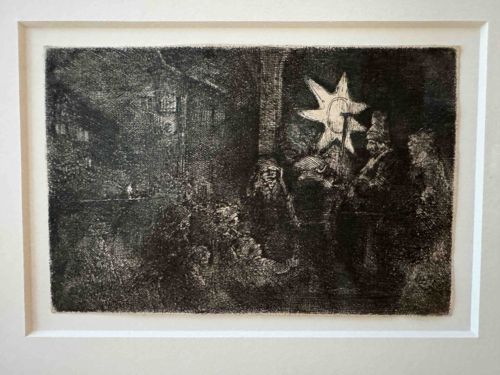
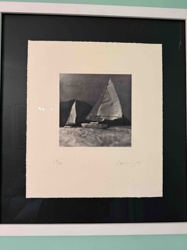
This item is an unframed, matted monochrome print, appearing to be an etching or engraving on paper. The artwork depicts a nocturnal scene, likely an interpretation of a biblical or historical event, specifically 'The Star of the Kings: A Night Piece' by Rembrandt van Rijn, dated circa 1651. The composition features a central, luminous, multi-pointed star acting as a light source for a group of figures gathered below. The figures, rendered with varying degrees of detail, appear to be a procession or gathering, possibly including the Three Wise Men or similar historical/religious characters, given the context of the star. The background suggests architectural elements of a building or city, along with some foliage. The overall color palette is limited to shades of black, gray, and white, characteristic of printmaking. The print itself exhibits signs of age and wear. The lines, particularly in darker areas, show some fading and loss of crispness, consistent with the 'faded and worn' description. There is visible evidence of the paper's texture throughout the print, and the dark tones appear somewhat desaturated or 'washed out' in certain areas. The edges of the print (where it meets the mat) seem relatively clean, but the overall impression is one of age and handling. There are no obvious tears or creases visible within the print area, but the aged appearance suggests a delicate state. No clear maker's marks or signatures are discernable from the provided image, a common challenge with older prints that may have faded or were trimmed. The print is presented within a white mat board, which shows some slight discoloration or dust accumulation along its inner edge directly bordering the print, especially noticeable in the top and bottom sections. The mat itself appears to be of standard archival quality, but this cannot be confirmed without closer inspection. The absence of a frame suggests it is currently in storage or awaiting framing. The craftsmanship of the print, despite its age and condition, points to a high level of detail and artistic skill in its original creation, capturing light and shadow effectively.
AI Appraisal Report
Upon visual examination of this print, identified as Rembrandt's 'The Star of the Kings: A Night Piece' (c. 1651), I note its significant age and condition issues. The unframed, matted monochrome etching exhibits notable fading and wear, with a visible loss of crispness in the lines and desaturation in the darker, inked areas. While the composition remains a powerful example of Rembrandt's mastery of chiaroscuro, its condition places it at the lower end of the market for his original works.
The authenticity of Rembrandt prints is a complex field. While the image is consistent with the known composition (Bartsch 113), determining if this is a lifetime impression, a later state, or a posthumous printing is impossible from photographs alone. The lack of a visible watermark or signature, combined with the worn state of the plate impression, suggests it may be a later, posthumous pull or a copy. Comparable sales for authenticated but worn lifetime impressions can reach several thousand dollars, but high-quality posthumous prints or copies often sell for significantly less. Given the high probability of this being a later impression or copy due to its condition and the lack of provenance, its value is drastically impacted.
For a conclusive valuation and authentication, an in-person examination is essential to inspect the paper for watermarks (such as the Fool's Cap, common for this print), analyze the ink, and assess the impression quality under magnification. Without such verification and supporting provenance documentation, this piece must be appraised cautiously as a decorative work in the style of Rembrandt.