These notes were written by the person who submitted this item. Appraiser.AI has not verified them, and the AI's identification and estimate may rely on them.
AI Estimated Value
Not an official valuation
$75 - $150
AI estimate as of July 21, 2025 · verify with a professional before acting
AI-Generated · Verify before acting
Everything on this page is generated by AI for informational purposes only. AI can make mistakes — the AI may misidentify items or misattribute them (artist, maker, brand, designer, origin, era). This is not an official valuation and should not be used for insurance, sale, tax, estate, legal, or lending purposes — or any decision requiring a certified appraisal. It is not an authoritative claim about any person, brand, or rights holder — do not share or rely on it as a factual statement about a third party. Always consult qualified professionals before making financial decisions.
This analysis also relies on unverified notes provided by the user, which may be incomplete or inaccurate and could affect the result.
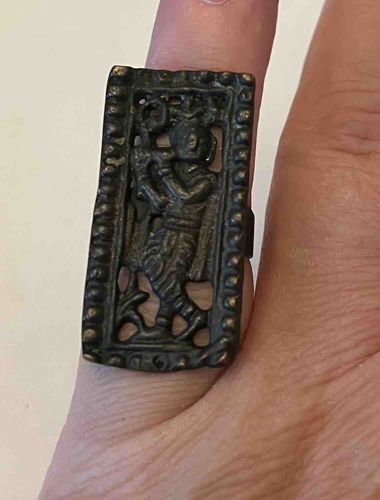
This item is an antique or vintage-style rectangular ring featuring an openwork design depicting a human, possibly deity, figure. The ring's face is elongated and rectangular, with outer dimensions appearing to be approximately 3-4 cm in height and 1.5-2 cm in width, though precise measurements are not available. The material appears to be a dark, patinated metal, likely bronze, copper, or a base metal alloy, given its aged, brownish-black finish. The surface exhibits a rich, dark patina consistent with age and oxidation, with some lighter areas on raised edges suggesting wear or recent handling. The frame of the rectangular face is adorned with a repetitive, textured pattern, possibly small raised dots or beads, which adds to its antique aesthetic. The central motif is a detailed, relief-sculpted figure, seemingly a standing individual holding an object (possibly a staff or musical instrument) in their right hand, with intricate details suggesting traditional attire or religious iconography. The figure's left arm is not clearly visible but appears to be bent. Below the figure, there are openwork elements that resemble foliage or decorative scrollwork. The craftsmanship is intricate, suggesting a cast piece with hand-finished details. There are no visible maker's marks or signatures from the provided image. The ring features an adjustable band, which is a common characteristic of costume jewelry or items designed for a wider range of finger sizes. The overall condition shows signs of age-appropriate wear, including surface scratches and rubbing, particularly on the edges and raised areas of the design. The dark patina is generally even, indicating good preservation of the metal. This piece appears to be a statement ring, likely from the early to mid-20th century, or possibly an earlier ethnographic piece, given its stylistic elements and material characteristics.
AI Appraisal Report
Based on my visual examination of the provided image, this Antiqued Metal Openwork Figure Ring presents as an intriguing piece of costume jewelry, likely from the early to mid-20th century. The dark, patinated metal, possibly bronze or a base alloy, displays an attractive aged finish consistent with its described vintage nature. The openwork figure, while detailed, suggests a cast piece rather than high-end hand-sculpting, and the adjustable band is a hallmark of costume or broader-market pieces.
Condition appears age-appropriate, with expected surface wear and robust patina. Authenticity as a period piece seems plausible based on the visual cues, but without physical inspection, I cannot verify the exact metal composition or manufacturing techniques. The intricate design aligns with a decorative, statement-ring aesthetic that was popular. From what I can discern, there are no red flags suggesting it is a modern reproduction attempting to deceive.
Market conditions for vintage costume jewelry are generally moderate. While unique designs like this attract collectors, the lack of precious metals, gemstones, or a known maker limits its top-tier value. Comparables would include other vintage base metal figural rings. Demand is niche; it would appeal to collectors of ethnographic-style jewelry or those seeking distinctive statement pieces. Its rarity is modest; while the specific design is unique, similar adjustable base metal rings appear periodically in the market.
Factors significantly impacting value include the non-precious metal, the adjustable band, and the absence of a discernible maker. To definitively authenticate and provide a more precise valuation, I would require in-person examination to assess the metal quality, craftsmanship nuances, and confirm the patina. Provenance documentation, if available, would also be invaluable. Scientific testing (e.g., XRF analysis for metal composition) would be necessary for full authentication. Without these, the assessment remains based solely on visual cues.