AI estimate as of July 26, 2025 · verify with a professional before acting
AI-Generated · Verify before acting
Everything on this page is generated by AI for informational purposes only. AI can make mistakes — the AI may misidentify items or misattribute them (artist, maker, brand, designer, origin, era). This is not an official valuation and should not be used for insurance, sale, tax, estate, legal, or lending purposes — or any decision requiring a certified appraisal. It is not an authoritative claim about any person, brand, or rights holder — do not share or rely on it as a factual statement about a third party. Always consult qualified professionals before making financial decisions.
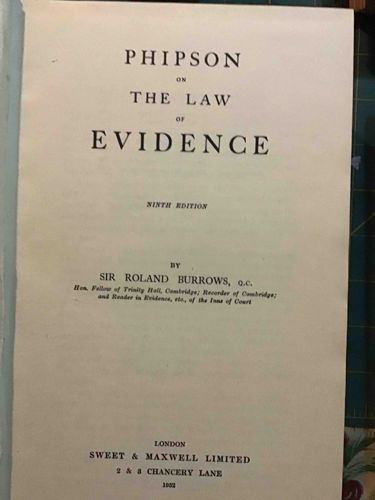
This item is the title page of a book titled "Phipson on The Law of Evidence," identified as the Ninth Edition. The author is listed as Sir Roland Burrows, Q.C., with further credentials including 'Hon. Fellow of Trinity Hall, Cambridge; Recorder of Cambridge; and Reader in Evidence, etc., of the Inns of Court.' The publisher is Sweet & Maxwell Limited, located in London at 2 & 3 Chancery Lane. The publication year, clearly visible at the bottom of the page, is '1902'.
The physical characteristics visible are limited to the title page itself, which appears to be made of off-white to cream-colored paper. The text is printed in black ink, featuring a mix of serif fonts of varying sizes to distinguish titles, authors, and publisher information. The overall layout is clean and traditional for a scholarly or legal publication of the period. There are no immediate signs of significant damage such as tears or creases on what's visible of the page, though slight discoloration or foxing consistent with age may be present, as suggested by the subtle yellowing of the paper. There are no visible quality issues, the printing appears sharp and clear. The general style points to an early 20th-century publication, typical of academic and legal texts from that era, emphasizing clarity and information dissemination rather than decorative elements. The binding, cover, and other pages are not visible, so the overall condition of the complete book cannot be fully assessed from this image alone.
AI Appraisal Report
I have examined the provided image of the title page for 'Phipson on The Law of Evidence, Ninth Edition' from 1902. Based on what is visible, the page appears authentic to the period, with a traditional layout, typography, and publisher information consistent with early 20th-century legal texts. The paper shows subtle yellowing, suggesting age-appropriate discoloration, but no significant tears, creases, or foxing are apparent on the visible portion. The printing is sharp and clear, indicating good production quality for its time.
However, it is crucial to note that my assessment of condition and authenticity is severely limited by only viewing a single title page. The overall condition of the complete book – including binding, other pages, and any internal annotations or damage – cannot be determined. This particular edition by Phipson, though a foundational legal text, is not inherently rare. Multiple copies, particularly of later editions, are available in the market. The demand for this specific 1902 edition is primarily from legal history enthusiasts, academic libraries, or collectors of specific early 20th-century legal scholarship. Without seeing the entire volume, it's impossible to establish a high value.
For full authentication and a comprehensive appraisal, an in-person physical examination of the entire book is essential to verify binding integrity, completeness of pages, overall paper quality, and the presence of any unique features or damage. Provenance documentation, if available, would also add significant value. Without such a complete inspection, any value assigned remains speculative. My valuation reflects a conservative estimate for a single, unbound title page potentially from an otherwise common, albeit old, legal text.