AI estimate as of August 4, 2025 · verify with a professional before acting
AI-Generated · Verify before acting
Everything on this page is generated by AI for informational purposes only. AI can make mistakes — the AI may misidentify items or misattribute them (artist, maker, brand, designer, origin, era). This is not an official valuation and should not be used for insurance, sale, tax, estate, legal, or lending purposes — or any decision requiring a certified appraisal. It is not an authoritative claim about any person, brand, or rights holder — do not share or rely on it as a factual statement about a third party. Always consult qualified professionals before making financial decisions.
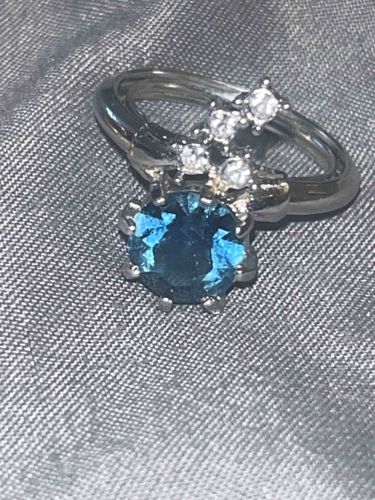
This item is a ring, appearing to be crafted from a silver-toned metal, possibly sterling silver, white gold, or platinum, given its bright, reflective surface. The ring features a prominent central gemstone, which is a vivid, round-cut blue stone, likely a London Blue Topaz, sapphire, or a similar gem, securely held by a six-prong setting. The facet patterns on this main stone indicate good cutting, allowing light to reflect and create a pleasing sparkle. Above and slightly to the side of the central blue stone, there is an asymmetrical cluster of smaller, round-cut clear gemstones, which appear to be diamonds or diamond simulants. There are approximately five of these smaller stones, each held by a four-prong setting. The arrangement of these accent stones gives the ring a modern or contemporary feel, perhaps evoking a celestial or organic design with a slight vine-like or starburst motif. The band of the ring is a simple, polished, and relatively thin design, which appears to split or have a slightly bypass-like structure where it connects to the main setting, enhancing the flow of the design. The metal shows some light surface wear consistent with use, such as minor scratches or scuffs, but no significant damage like deep gouges or bending is visible. The prongs holding the stones appear secure. The overall craftsmanship suggests a well-made piece, with attention to detail in the stone settings, indicating a quality piece of jewelry, likely from the late 20th or early 21st century.
AI Appraisal Report
Based on my visual examination of the provided image, this Gemstone Cluster Ring with Blue Center Stone appears to be in good pre-owned condition. I observe light surface wear, consistent with normal use, such as minor scratches on the metal, but no significant damage like deep gouges, bending, or missing stones. The prongs appear secure. Authenticity, based on imagery alone, suggests a natural blue gemstone, likely London Blue Topaz given its vivid blue hue and common use in similar styles, and clear accent stones that could be diamonds or diamond simulants. The metal appears to be a silver-toned alloy, potentially sterling silver, white gold, or platinum.
In terms of market conditions, similar cluster rings with natural or lab-created blue stones and diamond or simulant accents generally fetch values influenced by the specific materials. Demand for unique, non-traditional cluster designs remains steady, particularly for accessible price points. If the blue stone is London Blue Topaz and the clear stones are genuine diamonds, this significantly elevates the value compared to simulants. The craftsmanship, with secure prong settings, indicates a reasonably well-made piece.
Limitations regarding authenticity verification from images alone are significant. I cannot definitively confirm the metal purity (e.g., sterling silver vs. 14k white gold), the specific identity of the blue gemstone (e.g., London Blue Topaz vs. sapphire vs. synthetic spinel), or the nature of the clear accent stones (e.g., natural diamonds vs. moissanite vs. cubic zirconia). An in-person examination would allow for metal testing (e.g., acid test or XRF), gemological testing to determine refractive index and specific gravity for positive identification of the blue stone, and diamond testing for the accent stones. Documentation of provenance (e.g., original sales receipt, grading reports) would also be crucial for full authentication and precise valuation if it specifies materials.