These notes were written by the person who submitted this item. Appraiser.AI has not verified them, and the AI's identification and estimate may rely on them.
AI Estimated Value
Not an official valuation
$150-$250
AI estimate as of July 10, 2025 · verify with a professional before acting
AI-Generated · Verify before acting
Everything on this page is generated by AI for informational purposes only. AI can make mistakes — the AI may misidentify items or misattribute them (artist, maker, brand, designer, origin, era). This is not an official valuation and should not be used for insurance, sale, tax, estate, legal, or lending purposes — or any decision requiring a certified appraisal. It is not an authoritative claim about any person, brand, or rights holder — do not share or rely on it as a factual statement about a third party. Always consult qualified professionals before making financial decisions.
This analysis also relies on unverified notes provided by the user, which may be incomplete or inaccurate and could affect the result.
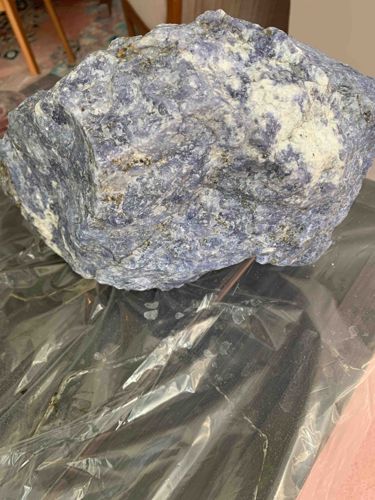
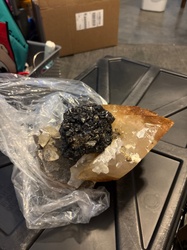
This specimen is a large, rough chunk of what appears to be Sodalite, as indicated by the characteristic mottled blue-gray and white coloration. The primary color is a varied spectrum of blue-gray, from deeper, more saturated tones to lighter, almost ethereal pale blue areas. Interspersed throughout the blue are significant veins and patches of white material, likely calcite or another associated mineral, creating a striking contrast and indicating a natural, unpolished state. The surface is uneven and rugged, exhibiting the natural cleavage planes and fracture patterns typical of a mined mineral, rather than a shaped or tumbled piece. Its size appears substantial, occupying a significant portion of the frame, suggesting a weight that could be several kilograms. Close inspection reveals areas of rough texture, with some crystalline structures or granular formations visible, especially where the white and blue minerals intermingle. There are no discernible markings, signatures, or manufacturing details, as is common for raw mineral specimens. The condition appears to be excellent for a raw mineral, with no obvious signs of significant damage, repairs, or unusual wear; any irregularities in its form are consistent with natural geological processes. The piece exhibits a natural, unrefined aesthetic, highlighting its intrinsic geological beauty and raw material quality.
AI Appraisal Report
I have examined the Rough Sodalite Mineral Specimen based on the provided image and descriptive details. My assessment indicates a large, authentic piece of rough sodalite, characterized by its mottled blue-gray and white coloration, consistent with natural sodalite intermingled with ancillary minerals like calcite. The condition appears to be excellent for a raw mineral, with natural cleavage planes and fracture patterns, and no obvious signs of damage or repairs, which enhances its appeal as an unrefined geological piece.
In terms of market conditions, large, attractive rough mineral specimens like this sodalite have a steady demand among collectors, interior decorators, and those interested in metaphysical properties. Comparables on the market for unpolished sodalite of this substantial size (likely several kilograms) typically range from reasonable to moderately high, depending on color saturation, matrix distribution, and overall aesthetic appeal. This specimen's striking blue-gray hues and contrasting white veins are particularly desirable.
Key factors impacting its value positively include its significant size and visually appealing natural form. The fact that it is a raw, unworked specimen maintains its intrinsic geological value. Negatively, while sodalite is not considered rare, specimens of this quality and size are less common than smaller pieces.
It is crucial to note the limitations of remote appraisal. While the visual characteristics strongly suggest genuine sodalite, absolute authenticity verification from images alone is not possible. A physical in-person examination would allow for tactile inspection, density testing, Mohs hardness testing, and a more precise weight assessment. Additionally, spectroscopic analysis could definitively confirm mineral composition. Provenance documentation, if available, documenting its origin, would further enhance its verifiable authenticity and value.