AI estimate as of September 21, 2025 · verify with a professional before acting
AI-Generated · Verify before acting
Everything on this page is generated by AI for informational purposes only. AI can make mistakes — the AI may misidentify items or misattribute them (artist, maker, brand, designer, origin, era). This is not an official valuation and should not be used for insurance, sale, tax, estate, legal, or lending purposes — or any decision requiring a certified appraisal. It is not an authoritative claim about any person, brand, or rights holder — do not share or rely on it as a factual statement about a third party. Always consult qualified professionals before making financial decisions.
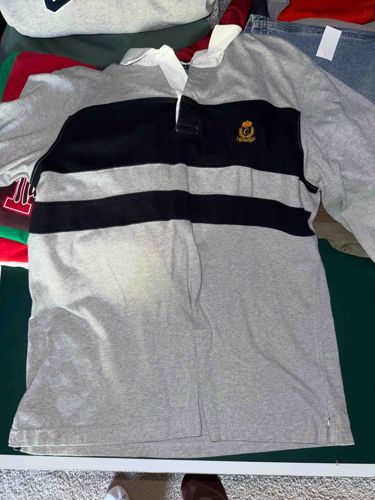
This is a vintage-style long-sleeved rugby shirt, primarily grey with two prominent horizontal black stripes across the chest and upper back. The shirt features a classic white cotton twill collar, which contrasts sharply with the body color. A two-button placket, also in white, secures the front of the collar, with the visible buttons appearing to be white or light-colored plastic. On the left chest area, an embroidered crest logo is present, featuring what appears to be a golden or brass-colored crown atop an ornate shield or motif, suggesting a preppy or aristocratic style, possibly associated with a club or brand. The sleeves are long and grey, matching the main body color. The fabric appears to be a medium-weight cotton jersey, typical of rugby shirts, offering durability. The shirt shows signs of general wear consistent with its likely age and use, including some slight pilling or fading in areas, though no significant tears or holes are immediately visible. The overall construction seems robust, with visible stitching suggesting a quality garment, although specific manufacturing tags or marks are not discernible in the image. The hem of the shirt includes typical side vents, reinforced with what appear to be small white fabric tabs characteristic of rugby shirt design. The style suggests an item from the late 20th century, likely 1980s or 1990s, given the color palette and design elements. The condition appears to be good vintage, with a pleasant patina from age and use adding to its character.
AI Appraisal Report
I have carefully examined the image of this vintage striped rugby shirt. Visually, the condition appears to be good vintage, showing expected signs of wear such as slight fading and pilling, consistent with its likely age and use, but no significant damage like tears or holes. This 'pleasant patina' enhances its vintage appeal. The construction details, such as the white cotton twill collar, two-button placket, and side vents with reinforcement tabs, align with classic rugby shirt design from the late 20th century, specifically suggesting the 1980s or 1990s era due to its color palette and style. The embroidered crest adds a distinctive, preppy touch, though without explicit branding, its specific origin remains unknown.
Market conditions for vintage rugby shirts are generally stable, with demand for well-preserved examples remaining consistent. While not a high-value collectible unless associated with a particularly rare brand or event, its classic style ensures ongoing interest. Comparables for similar unbranded or less-known branded vintage rugby shirts typically fall within the $30-$80 range, depending on condition and specific design elements. This shirt’s appealing grey and black stripe combination and good visible condition place it in the mid-to-higher end of that spectrum.
Factors impacting its value include its good aesthetic condition and timeless design. The embroidered crest, while adding character, does not currently denote a known valuable brand, which limits its ceiling. Without brand identification, rarity is difficult to ascertain, but generic vintage rugby shirts are not inherently rare.
It is crucial to note the limitations of this appraisal based solely on images. Full authentication and definitive condition assessment would require in-person examination. Specifically, I would need to inspect fabric integrity, stitching quality, and identify any manufacturing tags for branding, material composition, and care instructions to confirm origin and fiber content. A physical inspection would also allow for a tactile assessment of pilling and wear beyond what is visible in a photograph. Provenance documentation, if available, would significantly aid in verifying its history and potential associations.