AI Appraisal Estimate

AI-generated estimates · not official valuations

From the user

What was submitted

Photo and notes provided by the user — not generated by AI

Submitted item photo
Submitted photo · May 30, 2026

User's notes

No additional notes provided.

AI analysis below

AI appraisal

AI analysis & estimate

AI-Generated · Verify before acting

Everything below is generated by AI for informational purposes only. AI can make mistakes — the AI may misidentify items or misattribute them (artist, maker, brand, designer, origin, era). This is not an official valuation and should not be used for insurance, sale, tax, estate, legal, or lending purposes — or any decision requiring a certified appraisal. It is not an authoritative claim about any person, brand, or rights holder — do not share or rely on it as a factual statement about a third party. Always consult qualified professionals before making financial decisions.

Read the full disclaimer

AI Identification

·Not independently authenticated·Verify before acting

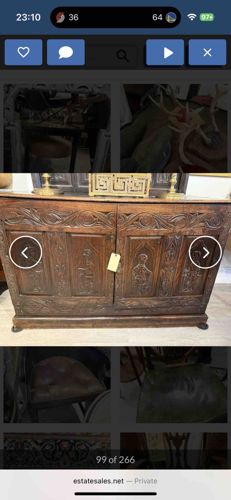
Heavily Carved Oak Tudor-Revival Credenza

Antique Furniture

AI Estimated Value

·Not an official valuation·Verify before acting

$1,800 - $2,500

As of May 30, 2026

AI Item Analysis

·AI can make mistakes·Verify before acting
This is a significant piece of dark-stained oak furniture, likely a credenza or sideboard, designed in the Tudor or Jacobean Revival style, commonly dating from the late 19th to early 20th century. The piece features two large doors with inset panels, each elaborately decorated with high-relief wood carvings. Notably, the center panels appear to depict humanoid figures or saints carved within arched niches, surrounded by foliate flourishes and scrolling vines across the top rails and side stiles. The construction demonstrates solid wood joinery typical of the period, with a heavy plinth base supported by small bun or flattened sphere feet. The dark oak finish shows a rich, aged patina with various tonal shifts suggestive of its age. While the general condition appears robust, there are visible signs of wear including minor surface abrasions, age-related wood grain expansion, and some dulling of the original finish in handled areas. A small paper inventory or price tag is hanging from the center handle/latch area. The craftsmanship is highly ornate, intended to mimic 16th-century English aesthetics, featuring deep-cut decorative motifs that provide significant texture and visual interest. No specific maker's mark is visible from this angle, but the uniformity of the carving suggests a skilled cabinetmaker from the Victorian or Edwardian revival periods.
AI Appraisal Report

·AI can make mistakes·Verify before acting
I have virtually examined this heavily carved oak Tudor-Revival credenza. Based on the deep-relief carvings of saints/humanoid figures and the dark-stained oak construction, this piece is a high-quality example of late 19th-century Victorian or early 20th-century Edwardian revivalism. The patina indicates a genuine age of roughly 120 years, with the surface abrasions and grain expansion reflecting expected wear through its lifespan. The heavy plinth base and hand-detailed foliate flourishes suggest a higher tier of craftsmanship than mass-produced furniture of the same era. The market for large-scale Tudor Revival furniture is currently stable but selective. Collectors value 'high-relief' carving over flat machine-work; this piece excels in that regard. Comparables for solid oak sideboards of this size and complexity typically fetch between $1,500 and $3,000 at specialized auction houses or antique galleries. The primary value-driver here is the central iconography, which adds a layer of narrative interest beyond standard floral motifs. However, a definitive valuation is limited by the digital nature of this inspection. To fully authenticate this item and potentially increase its valuation, an in-person examination is required to verify secondary woods (such as drawer liners) and joinery techniques (dovetails vs. nails) to confirm the exact manufacturing date. Provenance documentation or a maker’s mark—often hidden on the back panel or underside—would also significantly impact its marketability. Scientific testing is not typically required for this era, but a physical check for 'faking' (the distressing of newer wood to look old) is essential to rule out mid-20th-century replicas.

Get your items appraised

Instant estimates of your treasures with AI-powered appraisals

Browse More Appraisals