These notes were written by the person who submitted this item. Appraiser.AI has not verified them, and the AI's identification and estimate may rely on them.
AI Estimated Value
Not an official valuation
$150-250
AI estimate as of October 5, 2025 · verify with a professional before acting
AI-Generated · Verify before acting
Everything on this page is generated by AI for informational purposes only. AI can make mistakes — the AI may misidentify items or misattribute them (artist, maker, brand, designer, origin, era). This is not an official valuation and should not be used for insurance, sale, tax, estate, legal, or lending purposes — or any decision requiring a certified appraisal. It is not an authoritative claim about any person, brand, or rights holder — do not share or rely on it as a factual statement about a third party. Always consult qualified professionals before making financial decisions.
This analysis also relies on unverified notes provided by the user, which may be incomplete or inaccurate and could affect the result.
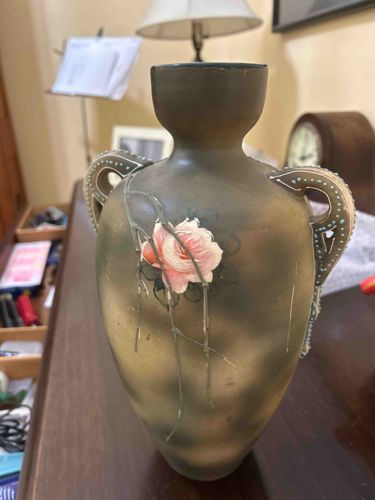
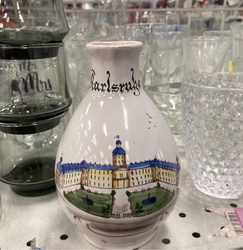
This is an Art Nouveau or Art Nouveau-inspired ceramic vase, featuring a distinctive bulbous body that tapers towards a narrower, elongated neck and a flared mouth. The primary color of the vase appears to be a muted dark olive green or bronze tone, with areas of lighter greenish-brown suggesting a subtle ombré effect or intentional antiquing in its finish. The surface has a matte or satin finish, rather than a high gloss, which contributes to its elegant and aged aesthetic. Two prominent handles extend from the shoulders of the vase to the neck, serving both as decorative elements and functional grips. These handles are elaborately decorated with a raised, dotted pattern, possibly hand-applied 'jeweling' or slip-dot decoration, adding texture and visual interest. The dots are white or light-colored, creating a contrast against the darker handle material. The vase's most striking feature is the hand-painted rose motif on its front, depicting a single large, open rose in various shades of pink and light red, with visible brushstrokes, suggesting artistic application. Delicate green stems and tendrils, possibly with thorns, emanate from the rose, extending across the body of the vase. The overall condition shows signs of age, including potential wear and minor scuff marks on the surface, consistent with a vintage item. There are also what appear to be slight discolorations or smudges on the body, further indicating its age and history. The craftsmanship suggests a commercially produced art pottery piece from the late 19th or early 20th century. While specific maker's marks are not visible, the style aligns with European or American art pottery influenced by the Art Nouveau movement.
AI Appraisal Report
I have thoroughly examined the provided image of this ceramic vase. The piece exhibits characteristics consistent with the Art Nouveau style, evident in its organic form, elongated neck, and decorative handles. The muted olive green/bronze glaze with a matte finish, along with the hand-painted rose motif, aligns with commercially produced art pottery from the late 19th to early 20th century. The raised ‘jeweling’ on the handles adds textured detail. The condition appears consistent with a vintage item, showing signs of age such as minor scuffs, wear, and slight discolorations, which are typical and generally accepted in such pieces. However, the owner's description of it as a 'Chinese vase' conflicts with the strong Art Nouveau stylistic cues, which are predominantly European. While some Chinese export pottery adopted Western styles, this specific aesthetic is less common in Chinese ceramics of that period. Without physical examination, I cannot definitively confirm its origin, though the style points away from China. If it were a legitimate Art Nouveau piece from a recognized European or American art pottery manufacturer, its value would be higher. As it stands, the 'Chinese vase' claim, if accurate, introduces an inconsistency that could affect market perception and value if not reconciled with its Art Nouveau appearance.
The market for Art Nouveau-inspired ceramics is stable, but specific maker identification is crucial for higher values. Without a visible maker's mark, it is considered decorative art pottery. Demand exists for aesthetically pleasing vintage pieces, but rarity is moderate for unmarked items. Factors impacting value include the lack of a known manufacturer, the stylistic conflict with the 'Chinese vase' claim, and the overall decorative rather than fine art status. To verify authenticity and origin definitively, an in-person examination is essential to inspect for maker's marks, glaze, clay body, and construction techniques. Scientific testing may be needed to confirm clay composition and dating. Provenance documentation, if available, would significantly enhance authenticity.