AI estimate as of July 5, 2025 · verify with a professional before acting
AI-Generated · Verify before acting
Everything on this page is generated by AI for informational purposes only. AI can make mistakes — the AI may misidentify items or misattribute them (artist, maker, brand, designer, origin, era). This is not an official valuation and should not be used for insurance, sale, tax, estate, legal, or lending purposes — or any decision requiring a certified appraisal. It is not an authoritative claim about any person, brand, or rights holder — do not share or rely on it as a factual statement about a third party. Always consult qualified professionals before making financial decisions.
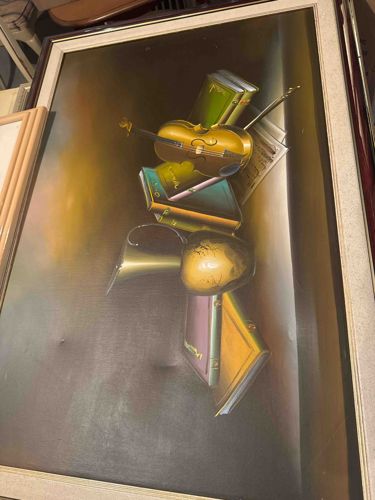
This is a large, vertically oriented oil painting depicting a still life composition of musical instruments and books. The primary colors in the composition are warm browns, golds, and greens, with accents of purple and yellow. The background transitions from a lighter, almost glowing area on the left to a darker, shadowy right side. Prominently featured are a golden-toned violin with its bow, what appears to be a brass horn or trumpet bell, and several closed books of varying sizes and colors (green, teal, purple/pink, and yellow). There is also a piece of sheet music visible near the top right. The objects are arranged in a dynamic, seemingly precarious stack or cluster, suggesting movement or an unconventional perspective. The painting exhibits signs of age and handling, including visible scratches, scuffs, and areas of grime on the dark background, particularly noticeable in the bottom left quadrant. The canvas itself shows some indentations or subtle warping. It is housed in a simple, likely wooden, frame with a light, possibly off-white or beige finish, showing minor wear. No visible artist's signature or specific manufacturing marks are discernible from the provided image. The style appears to be representational with a somewhat dramatic lighting scheme, possibly characteristic of mid to late 20th-century still life artwork, though a more precise age would require closer inspection. The craftsmanship appears to be proficient, with good rendering of light and shadow, and a smooth application of paint.
AI Appraisal Report
I have examined the provided image of a vertically oriented oil painting depicting a still life with musical instruments and books. Based on my visual assessment, the condition of the painting is fair to good. There are visible signs of age and handling, including scratches, scuffs, and grime, particularly in the darker background areas. The canvas exhibits some indentations or subtle warping. The frame appears simple and worn. There is no visible artist's signature, which limits authenticity verification from this image alone. The craftsmanship appears proficient, with good rendering of light and shadow, suggesting a skilled hand.
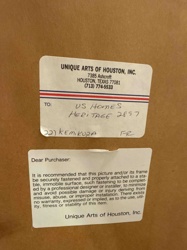
Given the lack of a discernible signature and provenance documentation, the authenticity cannot be definitively determined without in-person examination. For full authentication, I would require a physical inspection to assess paint quality, substrate, and age more precisely, and to search for hidden signatures or marks. Provenance documentation (history of ownership) is crucial for establishing authenticity and artist attribution. Scientific testing (e.g., pigment analysis, carbon dating of canvas) could further corroborate age and materials.
Market conditions for unsigned representational still life paintings by unknown artists are generally modest. Comparable items, typically decorative in nature, would fall into the range of $300-$800, depending on size, actual condition, and aesthetic appeal. While aesthetically pleasing, the lack of artist attribution significantly impacts value. Demand for such pieces without known artists tends to be from general home decorators rather than serious collectors. Rarity is not a factor here, as unsigned still lifes are relatively common. The primary factors influencing this appraisal value are its decorative appeal, fair condition, and the absence of artist attribution or provenance.