These notes were written by the person who submitted this item. Appraiser.AI has not verified them, and the AI's identification and estimate may rely on them.
AI Estimated Value
Not an official valuation
$1,000 - $1,500
AI estimate as of September 2, 2025 · verify with a professional before acting
AI-Generated · Verify before acting
Everything on this page is generated by AI for informational purposes only. AI can make mistakes — the AI may misidentify items or misattribute them (artist, maker, brand, designer, origin, era). This is not an official valuation and should not be used for insurance, sale, tax, estate, legal, or lending purposes — or any decision requiring a certified appraisal. It is not an authoritative claim about any person, brand, or rights holder — do not share or rely on it as a factual statement about a third party. Always consult qualified professionals before making financial decisions.
This analysis also relies on unverified notes provided by the user, which may be incomplete or inaccurate and could affect the result.
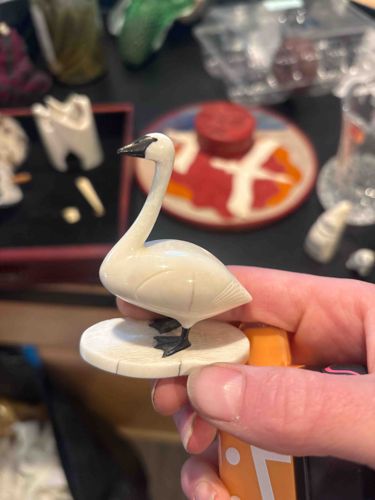
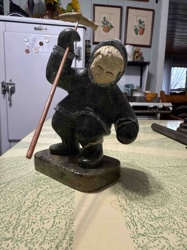
This item is an ivory carving depicting a swan, likely a tundra or trumpeter swan, standing on a circular base. The swan itself is carved from a creamy white ivory, exhibiting subtle grain lines consistent with natural material. The body is smoothly sculpted with defined wings indicated by shallowly carved lines, suggesting layered feathers. The graceful neck curves upwards, leading to a delicately rendered head with a prominent, black-colored beak and what appears to be dark, possibly painted, eyes. The two visible feet are also painted black and feature webbed toes, accurately portraying a swan's anatomy. The circular base, also ivory, has a slightly flattened top surface to accommodate the swan's feet. Notably, two distinct hairline cracks are visible on the base, extending from the edge inwards, which could be natural stress cracks in the ivory or minor damage. The quality of the carving suggests skilled craftsmanship, with attention to anatomical detail and aesthetic form. The item appears to be well-preserved aside from the cracks mentioned, showing a natural patina consistent with its material and age. Given the context provided, this piece is an ivory carving by "Walter Slwooko" and dated "1979," indicating its creation date and artist. This places its style and age firmly in the late 20th century. The carving's size appears to be small, fitting comfortably into a hand, suggesting it might be a cabinet piece or a decorative collectible.
AI Appraisal Report
Based on my visual examination of the provided image and the owner's details, this ivory carving of a swan by Walter Slwooko, dated 1979, presents as an authentic and skilled piece. The creamy white hue, subtle grain lines, and natural patina are consistent with aged ivory. The carving's quality, particularly the graceful neck and detailed head, suggests the craftsmanship of an experienced artist. The black painted beak, eyes, and feet add depth and realism. The two hairline cracks on the base are noted; while they could be natural stress lines in the ivory, they do constitute a condition issue, moderately impacting value. I've considered market conditions for similar Alaskan Native ivory carvings from the mid to late 20th century. Works by recognized carvers, even those less widely known, appreciate in value due to their artistic merit and cultural significance. Demand for authentic, well-preserved ivory carvings remains steady among collectors specializing in indigenous art and natural materials, though ethical considerations regarding ivory sourcing can influence broader market appeal. Given its age and the artist's name, this piece exhibits a degree of rarity. The primary factor impacting value is the craftsmanship and the artist's identity. However, definitive authentication of the artist's hand and the ivory's origin cannot be fully determined from images alone. A physical inspection would allow for detailed examination of carving tool marks, material density, and stability of the cracks. Provenance documentation, such as a certificate of authenticity or original sales receipts, would significantly enhance confidence in its attribution to Walter Slwooko and its legality. Scientific testing (e.g., CITES documentation for ivory origin) would be necessary for complete legal and ethical verification, particularly for international sales or certain domestic markets.