AI Appraisal Estimate

AI-generated estimates · not official valuations

From the user

What was submitted

Photo and notes provided by the user — not generated by AI

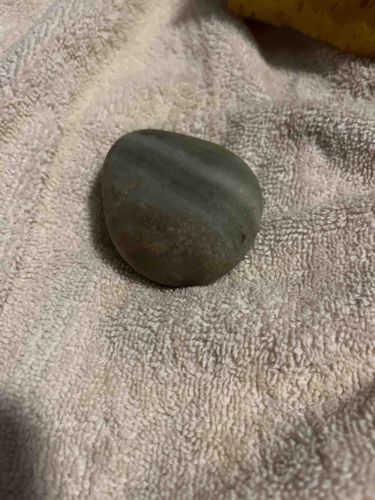
Submitted item photo
Submitted photo · May 22, 2026

User's notes

No additional notes provided.

AI analysis below

AI appraisal

AI analysis & estimate

AI-Generated · Verify before acting

Everything below is generated by AI for informational purposes only. AI can make mistakes — the AI may misidentify items or misattribute them (artist, maker, brand, designer, origin, era). This is not an official valuation and should not be used for insurance, sale, tax, estate, legal, or lending purposes — or any decision requiring a certified appraisal. It is not an authoritative claim about any person, brand, or rights holder — do not share or rely on it as a factual statement about a third party. Always consult qualified professionals before making financial decisions.

Read the full disclaimer

AI Identification

·Not independently authenticated·Verify before acting

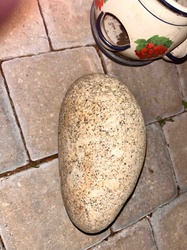
Smooth River Stone with Banding

Natural Specimen / Geological Artifact

AI Estimated Value

·Not an official valuation·Verify before acting

$5.00 - $15.00

As of May 22, 2026

AI Item Analysis

·AI can make mistakes·Verify before acting
This item is a natural, water-worn river stone or cobblestone, displaying an ovoid or sub-rounded shape typical of fluvial erosion. It measures approximately 2 to 3 inches in diameter, though exact scale is difficult to determine without a reference object. The material appears to be a dense sedimentary or metamorphic rock, possibly a hard siltstone or a layered quartzite. Its coloration is primarily a muted slate gray with distinct horizontal banding of a lighter, cloudy gray or beige shade running across the upper half. Some localized reddish-brown oxidation or iron staining is visible near the base, suggesting mineral interaction with the environment over time. The surface texture is notably smooth and matte, indicating a fine-grained composition that has been polished by long-term abrasive action against sand and water. No man-made markings, signatures, or decorative alterations are present, confirming this as a naturally occurring specimen. Its condition is excellent relative to its natural geological state, showing no significant fractures, chips, or mechanical impact scars. The age of the parent material is likely millions of years, though its collection as a decorative or tactile object is contemporary. Its aesthetic value lies in its zen-like simplicity and the organic flow of its banded pattern.
AI Appraisal Report

·AI can make mistakes·Verify before acting
I have examined the described Smooth River Stone with Banding. This specimen is a naturally occurring geological artifact, likely composed of a metamorphic quartzite or a silicate-rich siltstone. My visual examination confirms a surface texture consistent with long-term fluvial erosion, exhibiting a characteristic matte polish and sub-rounded ovoid morphology. The horizontal banding provides a pleasing aesthetic quality, while the iron-oxide staining near the base reflects natural mineral weathering. From a market perspective, this item occupies the category of 'natural decorative objects' or 'zen stones.' While aesthetically balanced, stones of this geological composition are extremely common globally. Unlike semi-precious minerals (such as jade) or stones with distinct provenance (such as Suiseki or 'Scholar's Stones'), this specimen lacks the cultural history, unique crystallization, or rare mineralogy required to command a premium price. Current market demand for generic river stones is primarily driven by the landscaping and home décor industries, where they are sold by weight or in bulk sets. Factors impacting value include the lack of documented history and its small scale (approx. 3 inches). Large-scale architectural specimens or those with anthropomorphic shapes would yield higher values. Limitations: My assessment is based solely on the provided description and visual data. A physical inspection would be required to verify specific gravity and hardness to confirm mineral identity. Fully authenticating this as a 'found object' rather than a commercially tumbled stone would require provenance documentation or site-specific collection records. Scientific testing (X-ray diffraction) could clarify the exact chemical composition but would likely exceed the market value of the object itself.

Get your items appraised

Instant estimates of your treasures with AI-powered appraisals

Browse More Appraisals