AI estimate as of December 11, 2025 · verify with a professional before acting
AI-Generated · Verify before acting
Everything on this page is generated by AI for informational purposes only. AI can make mistakes — the AI may misidentify items or misattribute them (artist, maker, brand, designer, origin, era). This is not an official valuation and should not be used for insurance, sale, tax, estate, legal, or lending purposes — or any decision requiring a certified appraisal. It is not an authoritative claim about any person, brand, or rights holder — do not share or rely on it as a factual statement about a third party. Always consult qualified professionals before making financial decisions.
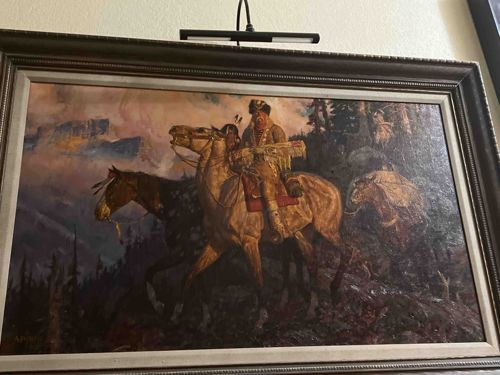
This is a large-format oil painting or possibly a high-quality giclee print on canvas, depicting a classic Western scene. The central figure is a fur trapper or mountain man, dressed in traditional buckskins and a fur cap, mounted on a light-colored horse. His horse is heavily laden with furs or provisions, suggested by the bundled items draped over the saddle and a long rifle visible. A second horse, darker in color with some dappling, follows behind, also appearing to carry packed goods. Both horses are adorned with feathers or other decorative elements associated with Native American or frontiersman culture. The background features a dramatic mountain landscape with a vibrant sky, transitioning from oranges and reds near the peaks to darker blues and purples in the lower valleys, suggesting either dawn or dusk. Dense coniferous forests populate the mid-ground and foreground, rendered with visible brushstrokes creating texture. On the far right, another, possibly third, pack animal or an animal carcass is faintly visible amidst the dark foliage, hinting at a successful hunt. The painting is housed within a substantial, ornate wooden frame with a gold-tone inner liner and a darker outer molding, indicating a traditional presentation. The frame appears to be in good condition with minor signs of wear consistent with age, such as slight scuffing. There is a visible artist's signature or inscription in the lower left corner, 'A. Probst' or similar, which would be crucial for exact artist identification. The overall condition of the painting appears good, with no obvious major damage, tears, or significant paint loss visible through the image. The colors are rich and well-preserved. The artwork is well-lit by an external picture light mounted above the frame. This piece exemplifies traditional Western art, likely from the mid-20th century or later, characterized by its detailed narrative, robust brushwork, and romanticized portrayal of frontier life.
AI Appraisal Report
Upon visual examination of the provided image, I assess this large-format Western-themed oil painting, 'Return from the Hunt' or 'Mountain Man.' The condition appears good overall; colors are rich, and there are no immediately visible tears, losses, or significant damage. The ornate wooden frame also appears in good condition with only minor age-consistent wear. The presence of a visible artist's signature, 'A. Probst' or similar, is crucial. Without physical inspection, I cannot definitively confirm if this is an original oil painting or a high-quality giclee print, which significantly impacts value. The nature of the brushwork, particularly in the foreground forests, suggests an original hand-painted piece, but further inspection is needed.
Market conditions for traditional Western art with romanticized frontier themes remain stable, with a consistent collector base. Original works by recognized Western artists command significant prices. Comparison to documented sales by artists like Probst (if accurately identified) or similar contemporaries would be key. If authenticated as an original 'A. Probst' oil painting, assuming it's a known artist, the value would lean higher. If it proves to be a well-executed giclee, the value would be considerably lower. Demand is steady for pieces in good condition depicting iconic Western narratives.
Limitations to this appraisal due to image-only viewing include the inability to verify the medium (oil vs. giclee), assess surface condition details like craquelure or texture, or authenticate the signature definitively. A physical examination for brushstroke analysis, paint layer assessment, and direct comparison to known works of 'A. Probst' is essential. Furthermore, provenance documentation (history of ownership) would be vital for full authentication and determining rarity.