AI Appraisal Estimate

AI-generated estimates · not official valuations

From the user

What was submitted

Photo and notes provided by the user — not generated by AI

Submitted item photo
Submitted photo · May 27, 2026

User's notes

No additional notes provided.

AI analysis below

AI appraisal

AI analysis & estimate

AI-Generated · Verify before acting

Everything below is generated by AI for informational purposes only. AI can make mistakes — the AI may misidentify items or misattribute them (artist, maker, brand, designer, origin, era). This is not an official valuation and should not be used for insurance, sale, tax, estate, legal, or lending purposes — or any decision requiring a certified appraisal. It is not an authoritative claim about any person, brand, or rights holder — do not share or rely on it as a factual statement about a third party. Always consult qualified professionals before making financial decisions.

Read the full disclaimer

AI Identification

·Not independently authenticated·Verify before acting

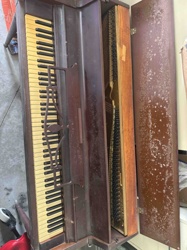
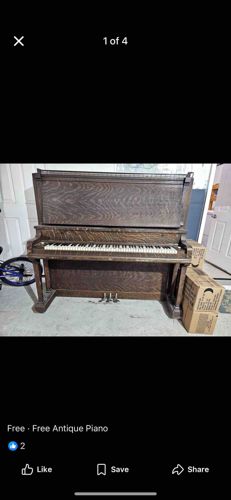
Early 20th Century Upright Piano in Quarter-Sawn Oak

Musical Instruments / Keyboard Instruments / Antiques

AI Estimated Value

·Not an official valuation·Verify before acting

$200 - $400

As of May 27, 2026

AI Item Analysis

·AI can make mistakes·Verify before acting
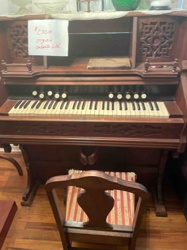
This is a full-sized vertical upright piano, likely dating from the late 19th to the early 20th century (circa 1890-1920). The instrument is constructed with a heavy wood cabinet featuring a prominent quarter-sawn oak veneer, characterized by its distinctive 'tiger-stripe' or flake grain pattern. The finish appears to be a dark stained shellac or lacquer that has aged considerably. The piano features a standard 88-key keyboard with visible wear and discoloration on the ivory or celluloid key tops; several keys appear slightly misaligned, suggesting the need for action regulation. The lower section includes three brass pedals (sustaining, una corda, and likely a practice or muffler pedal). Physically, the piece shows significant signs of age and neglect; there is extensive surface scuffing, water spotting, and finish loss along the keyboard lid and base. The top panel exhibits minor warping or separation, typical of instruments stored in non-climate-controlled environments. No specific maker's mark is visible on the exterior, though one would typically be found on the iron harp or soundboard inside the cabinet. The heavy, blocky legs and rectilinear silhouette are indicative of the Craftsman or Mission style influence prevalent during its suspected manufacturing era. Given its current visual state and storage location, a full internal restoration would likely be required for musical functionality.
AI Appraisal Report

·AI can make mistakes·Verify before acting
I have completed a visual assessment of this Early 20th Century Upright Piano. The piece reflects the heavy Mission or Craftsman style popular between 1890 and 1920, highlighted by a notable quarter-sawn oak veneer. While the veneer exhibits a desirable 'tiger-stripe' grain, the overall condition is poor. There is significant evidence of environmental stress, including water spotting, finish degradation, and potential delamination on the top panel. The keyboard shows uneven key height and significant yellowing, suggesting the internal action—the hammers, dampers, and felts—has likely reached the end of its functional life or suffered pest and humidity damage. The market for antique upright pianos is currently depressed. Unlike high-end grands, vintage uprights generally suffer from 'negative equity,' where restoration costs ($3,000–$10,000) far exceed the eventual retail value. Contemporary buyers prioritize portability and tuning stability, which aged instruments stored in non-climate-controlled environments rarely provide. The value resides primarily in the cabinet's aesthetic appeal as a furniture piece rather than a musical instrument. Without an in-person inspection, I cannot verify the integrity of the cast-iron plate or the soundboard, which are prone to cracking. A physical examination by a registered piano technician is required to determine if the pin block can still hold a tune. Furthermore, I would need to open the top lid to locate the serial number and manufacturer's name on the harp to determine if this is a prestigious maker (e.g., Steinway or Mason & Hamlin) or a common 'stencil' brand, which would slightly shift the value. As it stands, this is a decorative antique with high maintenance liabilities.

Get your items appraised

Instant estimates of your treasures with AI-powered appraisals

Browse More Appraisals