AI estimate as of September 20, 2025 · verify with a professional before acting
AI-Generated · Verify before acting
Everything on this page is generated by AI for informational purposes only. AI can make mistakes — the AI may misidentify items or misattribute them (artist, maker, brand, designer, origin, era). This is not an official valuation and should not be used for insurance, sale, tax, estate, legal, or lending purposes — or any decision requiring a certified appraisal. It is not an authoritative claim about any person, brand, or rights holder — do not share or rely on it as a factual statement about a third party. Always consult qualified professionals before making financial decisions.
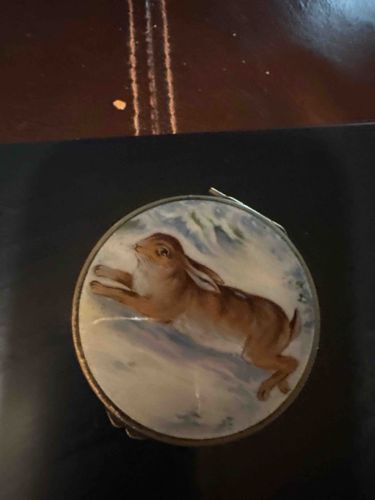
This exquisite item is an oval-shaped brooch featuring a meticulously hand-painted miniature of a hare against a wintry, snowy landscape background. The central oval element appears to be made of porcelain, enamel, or reverse-painted glass, set within a finely crafted metal bezel, likely silver or a silver-plated alloy, given the visible sheen and subtle tarnishing visible in some areas. The hare is depicted in mid-stride, showcasing dynamic movement with its front paws outstretched and hind legs propelling it forward. Its fur is rendered in shades of rich brown and tan, with delicate details suggesting texture and musculature. The background features soft blues and whites, indicative of snow-covered terrain and distant mountains or clouds, contributing to a sense of depth. The borders of the setting have a somewhat scalloped or decorative edge, although not clearly defined, adding to its artisanal appeal. Visible condition issues include minor surface wear consistent with age, such as slight abrasions or faint scratches on the painted surface and potential tarnish on the metal frame. There are no obvious signs of major damage or repairs, and the craftsmanship appears to be of high quality, suggesting it could be late 19th or early 20th century, possibly Victorian or Edwardian era due to its detailed miniature artwork style. The overall presentation indicates a piece designed for adornment, likely pinned to clothing.
AI Appraisal Report
Based on my visual examination of the provided image, this Oval Hand-Painted Hare Miniature Brooch appears to be a charming example of late 19th to early 20th-century miniature artwork. The central oval, likely porcelain or reverse-painted glass, features a finely detailed hand-painted hare in a wintry landscape, demonstrating considerable artistic skill. The depiction of the hare in mid-stride with textured fur and the atmospheric background contributes significantly to its aesthetic appeal. The metal bezel, likely silver or silver-plated, exhibits some subtle tarnishing, consistent with its age and material. Condition-wise, it shows minor surface wear, abrasions, or faint scratches on the painted surface and frame, which is expected for an item of this vintage and does not significantly detract from its value. There are no readily apparent signs of major damage or repair visible in the image.
Market conditions for antique miniature brooches, especially those depicting animals with good artistic merit, generally show steady demand. Items from the Victorian or Edwardian eras with detailed artistry are particularly sought after. While not exceedingly rare, a well-executed piece like this with a desirable subject matter ensures a reasonable level of interest from collectors of antique jewelry and miniatures. Comparables in the market for similar hand-painted miniature brooches, depending on the artist's reputation and preciousness of materials, can range anywhere from $150 for simpler pieces to $800+ for signed or exceptionally elaborate examples.
The main factor impacting value here is the quality of the miniature painting and the collectible nature of the subject (hare). The potential lack of precious metal in the setting (if silver-plated rather than solid silver) and the unsigned nature of the artwork would limit the upper end of its valuation. However, the overall craftsmanship and aesthetic appeal contribute positively.
It is crucial to note that my assessment is based solely on visual inspection of the image. For full authentication and a more precise valuation, an in-person examination would be required to assess the integrity of the painting surface, confirm the material composition of the bezel (e.g., sterling silver vs. plated base metal), and verify the type of miniature (e.g., porcelain vs. reverse-painted glass). Furthermore, provenance documentation, if available, could significantly enhance its value by confirming its history or potential artist attribution. Scientific testing might also be employed to definitively determine materials if necessary.