AI estimate as of November 8, 2025 · verify with a professional before acting
AI-Generated · Verify before acting
Everything on this page is generated by AI for informational purposes only. AI can make mistakes — the AI may misidentify items or misattribute them (artist, maker, brand, designer, origin, era). This is not an official valuation and should not be used for insurance, sale, tax, estate, legal, or lending purposes — or any decision requiring a certified appraisal. It is not an authoritative claim about any person, brand, or rights holder — do not share or rely on it as a factual statement about a third party. Always consult qualified professionals before making financial decisions.
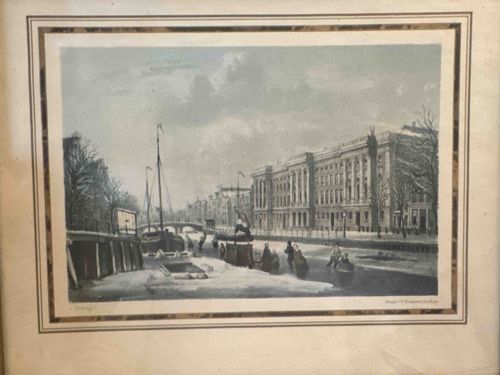
This item is a framed print depicting a winter scene of a canal in what appears to be a European city. The print showcases a large, ornate building along the right bank of the canal, featuring multiple stories, numerous windows, and decorative architectural elements, possibly in a neoclassical or Baroque style. The canal itself is partially frozen with ice, and several figures are visible on the ice, suggesting ice skating or walking. There are also boats, some moored along the bank and at least one with a mast rising prominently, suggesting it's either a sailing vessel or a larger barge. A bridge spans the canal in the mid-ground. Trees with bare branches, indicative of winter, dot the landscape. The sky is overcast and grey, contributing to the wintry atmosphere. The print itself has a border with a double line detail and a marbled or woodgrain pattern, which is then surrounded by a wider, off-white mat. The overall color palette is somewhat muted, dominated by blues, greys, and browns, with hints of green from the trees. The print appears to be hand-colored to some extent, especially in the sky and water. There are inscriptions at the bottom edge of the print; on the left, it reads "'S Hage" (presumably an abbreviation for Den Haag or The Hague), and on the right, it reads "Druk v. P. Blommers, Rottedam" (Printed by P. Blommers, Rotterdam). This suggests the print was produced in Rotterdam and depicts a scene from The Hague. The condition of the print appears good, with no obvious major damage visible, through there might be some slight discoloration or foxing on the matting due to age. The frame itself is not clearly visible, as the image focuses on the print and its immediate matting.
AI Appraisal Report
I have examined the provided image of the framed Winter Canal Scene Print. Based on my visual assessment, the print appears to be an intaglio (likely engraving or etching) that has been hand-colored, depicting a winter scene in 'S Hage (The Hague), printed by P. Blommers of Rotterdam. The print's condition appears good for its age, with no obvious major tears or significant creasing. There may be minor discoloration or foxing on the matting, which is common for antique prints and can be addressed through conservation if desired. The architecture suggests a European, likely Dutch, context consistent with the inscriptions.
Authenticity: The inscriptions "'S Hage" and "Druk v. P. Blommers, Rotte'dam" provide strong indicators of its origin and subject matter. P. Blommers was a known printmaker and publisher in Rotterdam during the 19th century. Without a physical inspection, it is difficult to definitively confirm the authenticity of the print as an original 19th-century impression versus a later reproduction. Visual nuances of paper type, plate marks, and coloring technique require in-person examination. Provenance documentation, such as prior sales records or exhibition history, would further aid in verification.
Market Conditions & Demand: European city scene prints from the 19th century, particularly those of specific identifiable locations, have a steady but not exceptionally high demand. Prints by lesser-known producers like P. Blommers, while historically interesting, generally do not command the prices of works by renowned artists. The hand-coloring adds a degree of individuality and visual appeal, which can slightly enhance value. However, it's a decorative item rather than a fine art investment piece.
Factors Impacting Value: The condition is a primary driver; any significant damage to the print itself would devalue it. The accuracy of the hand-coloring and the overall aesthetic appeal are also important. Rarity is moderate; while not mass-produced, prints from this era in this genre are not exceedingly scarce. The primary limitation to a definitive appraisal from an image is the inability to assess the paper, plate impression, and the nuances of the hand-coloring's age and technique. An in-person examination could confirm paper quality, presence of a plate mark, and the precise nature of the coloring, which would solidify the appraisal. Scientific testing (e.g., paper dating, pigment analysis) would be needed for absolute certainty on age and authenticity if questions arose. Based on current market trends for similar decorative 19th-century European prints, I estimate its value to be in the range of $150-250.