AI estimate as of August 20, 2025 · verify with a professional before acting
AI-Generated · Verify before acting
Everything on this page is generated by AI for informational purposes only. AI can make mistakes — the AI may misidentify items or misattribute them (artist, maker, brand, designer, origin, era). This is not an official valuation and should not be used for insurance, sale, tax, estate, legal, or lending purposes — or any decision requiring a certified appraisal. It is not an authoritative claim about any person, brand, or rights holder — do not share or rely on it as a factual statement about a third party. Always consult qualified professionals before making financial decisions.
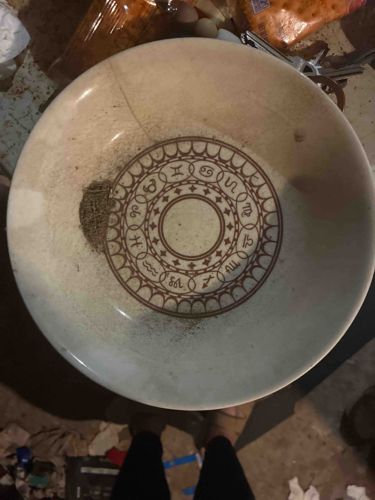
This item is a shallow, round bowl or plate, approximately 12-16 inches in diameter, crafted from what appears to be ceramic or stone-like material, possibly marble or a composite. Its primary color is an off-white or very light beige, with visible darker greyish or brownish veins and crackling, suggesting an aged or distressed aesthetic, or intrinsic natural patterns if stone. The surface has a noticeable sheen, indicating a polished or glazed finish. The most prominent feature is a circular, intricate design centrally placed, executed in a dark brown or sepia tone. This design consists of multiple concentric rings. The outermost ring of the central design features a scalloped or wavy border. Inside this, there's a ring containing twelve distinct symbols, which are clearly recognizable as astrological zodiac signs (e.g., Aries, Taurus, Gemini, Cancer, Leo, Virgo, Libra, Scorpio, Sagittarius, Capricorn, Aquarius, Pisces). These symbols are enclosed within individual, decorative segments. Closer to the center, there is another ring with smaller, repeating geometric patterns, such as crosses or stars, within individual units. The very center of the design is a plain, smaller circular area. The bowl exhibits significant signs of use and wear, particularly a dark, granular residue or staining, possibly dirt or debris, accumulating in one section of the bowl's interior and scattered lightly over other areas. There are prominent crack lines visible on the surface, particularly emanating from the edge towards the center, which could be part of the material's natural patina, stress fractures, or intentional distressing. The overall craftsmanship appears standard for decorative or utilitarian ware, with the printed astrological design indicating a manufactured item rather than hand-painted. Given the style of the astrological symbols and the general aesthetic, it likely dates from the late 20th century or early 21st century.
AI Appraisal Report
I have examined the provided image of the Astrological Zodiac Display Bowl/Plate. This item appears to be a mass-produced decorative piece, likely from the late 20th to early 21st century. The material seems to be a ceramic or composite with a glazed finish, designed to mimic ancient stone. The prominent 'veins' and 'crackling' appear to be intentional distressing or part of the manufacturing process, rather than genuine age-related wear, although without physical inspection, I cannot confirm this. The dark residue and superficial cracking suggest significant use or poor storage; these are condition issues that detract from value. The astrological design, while clear, appears to be a transfer print rather than hand-painted, typical of decorative homeware.
Market conditions for such items are generally modest. Similar mass-produced decorative bowls, especially without a known maker or particularly artistic merit, do not command high prices. Demand for astrological themed decor exists, but supply often outweighs it. Rarity is low as these are commonly produced items. Factors significantly impacting value are the non-precious materials, the mass-produced nature, and the apparent condition issues.
Limitations in authenticity verification are significant based solely on images. Without a physical examination, I cannot conclusively determine the material (e.g., actual stone vs. composite), differentiate between intentional distressing and genuine damage, or confirm the manufacturing technique (e.g., printed vs. hand-painted transfers). Scientific testing would be needed to identify the precise material composition. Provenance documentation, for instance, a receipt from purchase, would offer insights into its origin and initial cost, though it is unlikely for such an item to have extensive provenance.