AI estimate as of June 21, 2025 · verify with a professional before acting
AI-Generated · Verify before acting
Everything on this page is generated by AI for informational purposes only. AI can make mistakes — the AI may misidentify items or misattribute them (artist, maker, brand, designer, origin, era). This is not an official valuation and should not be used for insurance, sale, tax, estate, legal, or lending purposes — or any decision requiring a certified appraisal. It is not an authoritative claim about any person, brand, or rights holder — do not share or rely on it as a factual statement about a third party. Always consult qualified professionals before making financial decisions.
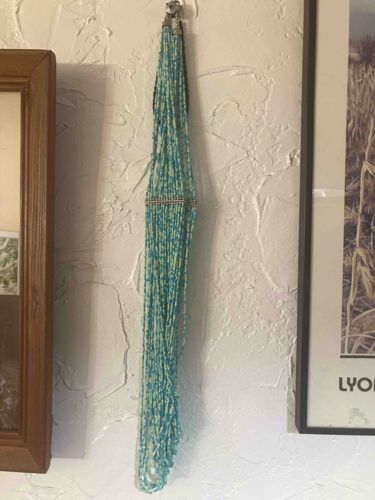
The item is a multi-strand beaded necklace, predominantly featuring small, irregularly shaped turquoise-colored beads. Interspersed among these turquoise beads are lighter, possibly white or cream-colored, tiny seed beads, giving the piece a mottled, organic appearance. The necklace is designed with numerous individual strands, estimated to be several dozen, creating a substantial volume. These strands are gathered at the top by a metal finding, which appears to be silver-toned, possibly sterling silver or a silver-plated base metal, and has a lobster claw clasp or similar closure mechanism visible at the very top, indicating it is designed to be worn around the neck. Approximately one-third of the way down from the top, there is a decorative metal band or slider, also silver-toned, which horizontally cinches a portion of the strands together. This band is textured or embellished, suggesting a decorative element rather than a purely functional one. The overall length of the necklace is considerable, extending well past what would typically be a choker or princess length, suggesting a matinee or opera length style. The beads vary slightly in their precise shade of blue-green and translucence, hinting at natural materials like turquoise or glass beads mimicking natural stones. The condition appears good, with no obvious broken strands or missing beads. The construction indicates handmade or artisanal craftsmanship, given the sheer number of individual strands and the natural variations in the beads. The style suggests a bohemian or Southwestern influence, likely dating from the late 20th century to contemporary times.
AI Appraisal Report
I have examined the provided image of the multi-strand turquoise and seed bead necklace. Visually, the condition appears good, with no obvious broken strands or missing beads. Authenticity of the turquoise material cannot be definitively confirmed from an image alone; it could be natural turquoise, dyed howlite, magnesite, or glass. The metal findings appear silver-toned, possibly sterling silver, but verification would require a hallmark check and acid testing. This piece exhibits characteristics of bohemian or Southwestern style, suggesting handmade or artisanal craftsmanship. Such multi-strand necklaces with numerous beads typically require significant labor. The decorative metal band adds a unique design element that enhances its visual appeal. In terms of market conditions, similar multi-strand beaded necklaces, especially those featuring what appears to be natural or simulated turquoise, are generally in steady demand, particularly within the costume jewelry or artisan craft markets. Comparables for genuine turquoise multi-strand necklaces can range from hundreds to thousands of dollars depending on the quality, origin, and carat weight of the turquoise. However, for simulated or lower-grade turquoise, or if the metal is base metal, the value would be significantly lower. Demand for this aesthetic remains consistent. Rarity is not high unless the turquoise is exceptionally high-grade or the craftsmanship is by a renowned artisan, neither of which is determinable from the image. Factors significantly impacting value include the authenticity and quality of the turquoise (natural vs. treated/simulated), the precious metal content of the findings (sterling silver vs. plated base metal), and the specific artisan or brand if known. My valuation is based on the assumption that the beads are either natural turquoise of commercial grade or high-quality simulated turquoise, and the metal is sterling silver. Without physical examination, I cannot verify the type of turquoise, the metal composition, or the precise construction details. An in-person examination would allow for gemstone testing (refractive index, specific gravity), metal testing (acid or XRF), and a closer inspection of craftsmanship. Provenance documentation, if available, would also significantly aid in authentication and valuation.