AI Appraisal Estimate

AI-generated estimates · not official valuations

From the user

What was submitted

Photo and notes provided by the user — not generated by AI

Submitted item photo
Submitted photo · June 6, 2026

User's notes

No additional notes provided.

AI analysis below

AI appraisal

AI analysis & estimate

AI-Generated · Verify before acting

Everything below is generated by AI for informational purposes only. AI can make mistakes — the AI may misidentify items or misattribute them (artist, maker, brand, designer, origin, era). This is not an official valuation and should not be used for insurance, sale, tax, estate, legal, or lending purposes — or any decision requiring a certified appraisal. It is not an authoritative claim about any person, brand, or rights holder — do not share or rely on it as a factual statement about a third party. Always consult qualified professionals before making financial decisions.

Read the full disclaimer

AI Identification

·Not independently authenticated·Verify before acting

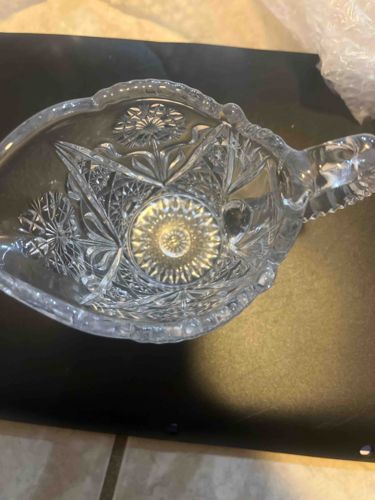
Cut Glass Gravy Boat or Sauce Dish

Serveware

AI Estimated Value

·Not an official valuation·Verify before acting

$40-70

As of June 6, 2026

AI Item Analysis

·AI can make mistakes·Verify before acting
The item is a clear glass serving dish, most likely a gravy boat or a sauce server, distinguished by its intricate cut or pressed glass patterns. It features a boat-like or elongated oval shape with a pronounced handle extending from one end, and a slightly flaring rim that appears to be gently scalloped or undulating. The primary material is clear, colorless glass, exhibiting a high degree of transparency and refractive qualities indicative of cut or high-quality pressed glass. The surface is adorned with a complex pattern, primarily featuring hobstar and fan motifs, characteristic of the American Brilliant Period or similar vintage glassware. A prominent hobstar design can be seen in the center of the base, surrounded by a radiant burst of star-like cuts and intricate fan-shaped patterns that extend towards the edges. The handle also appears to have some sort of textured or patterned surface, enhancing grip and visual appeal. No visible manufacturing marks or signatures are discernible from the provided images. The condition appears to be good with no obvious chips, cracks, or significant fleabites, though a thorough inspection for minor wear consistent with its age would be necessary. The overall craftsmanship suggests a mass-produced yet finely detailed item, likely from the late 19th to mid-20th century.
AI Appraisal Report

·AI can make mistakes·Verify before acting
I have virtually examined this clear cut or pressed glass gravy boat, noting its intricate hobstar and fan motifs characteristic of vintage American Brilliant Period-style glassware. The elongated oval shape, pronounced handle, and scalloped rim enhance its decorative appeal. Visually, the condition appears good, with no obvious chips, cracks, or significant fleabites, suggesting careful handling over the years. This quality of preservation positively influences its value. Authenticity, based solely on imagery, points towards a mass-produced item from the late 19th to mid-20th century. While it exhibits patterns similar to the American Brilliant Period, without physical inspection, distinguishing true cut glass from high-quality pressed glass is impossible. This distinction is crucial, as hand-cut pieces generally command higher values than pressed glass. Market conditions for vintage pressed or cut glass serving pieces like this are moderate. While there's a steady collector base, the supply is relatively ample, preventing significant price increases. Comparable items in good condition typically sell in the $40-$70 range. Demand is stable; however, rarity is low for common patterns. Factors significantly impacting value include the actual manufacturing process (cut vs. pressed), the specific glass manufacturer (if identifiable), and any unique design elements. The absence of maker's marks is common but limits specific attribution. For full authentication, an in-person examination is critical to confirm if it is true hand-cut glass or pressed glass, to precisely assess minor wear such as faint scratches or fleabites not visible in images, and to check for any hidden manufacturer's marks. Provenance documentation would also greatly assist in confirming its age and origin, but is rarely available for such common items.
Get your items appraised

Instant estimates of your treasures with AI-powered appraisals

Browse More Appraisals