AI estimate as of October 8, 2025 · verify with a professional before acting
AI-Generated · Verify before acting
Everything on this page is generated by AI for informational purposes only. AI can make mistakes — the AI may misidentify items or misattribute them (artist, maker, brand, designer, origin, era). This is not an official valuation and should not be used for insurance, sale, tax, estate, legal, or lending purposes — or any decision requiring a certified appraisal. It is not an authoritative claim about any person, brand, or rights holder — do not share or rely on it as a factual statement about a third party. Always consult qualified professionals before making financial decisions.
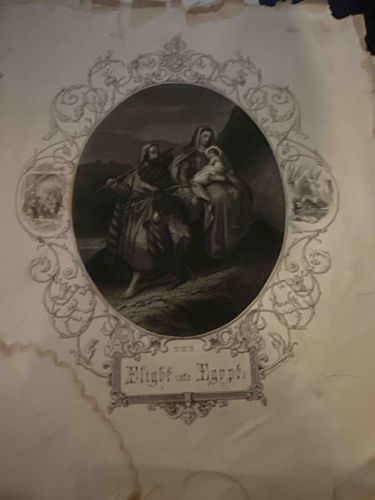
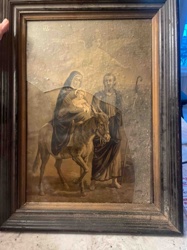
This item is an antique engraving or print titled "The Flight into Egypt." The central image is oval-shaped and depicts a scene from the New Testament: Mary, Joseph, and the infant Jesus fleeing to Egypt. Mary is shown holding the baby Jesus, while Joseph leads the donkey on which they are traveling through a dark, presumably mountainous or rugged, landscape. The print is presented in a monochrome palette, likely black and white or sepia tones, common for engravings of its era. Surrounding the central oval is an elaborate, ornate scrollwork frame, suggesting a decorative purpose beyond just the religious narrative. This frame also incorporates two smaller, ancillary narrative scenes or medallions on either side of the main image, though their specific content is difficult to discern due to the image quality. Below the central oval, the title "THE Flight into Egypt" is prominently displayed in a decorative, gothic-style script, set within another stylized cartouche. The paper itself shows significant signs of age and wear, including discoloration, staining, and visible watermarks or foxing, particularly around the edges. The delicate edges appear tattered and irregularly shaped, indicating fragility and potential damage from handling or moisture over time. There are also visible tears along the top edge. The overall presentation suggests a piece that was likely part of a larger publication, such as a Bible, an illuminated manuscript, or a collection of religious illustrations, possibly from the 19th century or earlier due to its style and condition. The craftsmanship of the engraving appears detailed, demonstrating fine lines and shading, characteristic of period printmaking techniques.
AI Appraisal Report
Based on my visual examination of the provided image, this antique engraving titled "The Flight into Egypt" presents as a 19th-century or potentially earlier religious print. The monochrome palette, detailed line work, and ornate scrollwork frame are consistent with period printmaking. The significant signs of age, including discoloration, staining, foxing, tattered edges, and tears, indicate considerable wear and fragility. While these condition issues detract from its aesthetic appeal, they also attest to its age and authenticity as an antique. Market conditions for single religious prints of this nature, especially those with significant condition issues, are generally modest. Comparable items, often found in antique print shops or online marketplaces, typically range from $50 to $200 depending on the artist, rarity, and condition. The lack of a discernible artist signature or publisher information limits its specific collectible value. Demand for general antique religious engravings is stable but not exceptionally high, making it a niche item. Factors significantly impacting value here are the extensive damage and the absence of a known prominent artist. Without a physical inspection, I cannot verify the paper type, printing technique details, or confirm if it was part of a larger publication. Full authentication would require in-person examination to assess paper fibers, watermarks, plate marks, and ink composition. Provenance documentation, such as collection history or purchase records, would also greatly aid in definitively establishing its origin and authenticity.