AI Appraisal Estimate

AI-generated estimates · not official valuations

From the user

What was submitted

Photo and notes provided by the user — not generated by AI

Submitted item photo
Submitted photo · May 30, 2026

User's notes

No additional notes provided.

AI analysis below

AI appraisal

AI analysis & estimate

AI-Generated · Verify before acting

Everything below is generated by AI for informational purposes only. AI can make mistakes — the AI may misidentify items or misattribute them (artist, maker, brand, designer, origin, era). This is not an official valuation and should not be used for insurance, sale, tax, estate, legal, or lending purposes — or any decision requiring a certified appraisal. It is not an authoritative claim about any person, brand, or rights holder — do not share or rely on it as a factual statement about a third party. Always consult qualified professionals before making financial decisions.

Read the full disclaimer

AI Identification

·Not independently authenticated·Verify before acting

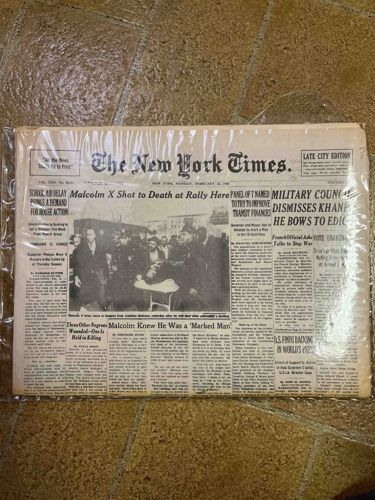
The New York Times - February 22, 1965 Issue

Historical Ephemera / Newspapers

AI Estimated Value

·Not an official valuation·Verify before acting

$450 - $650

As of May 30, 2026

AI Item Analysis

·AI can make mistakes·Verify before acting
This is a significant historical edition of The New York Times, 'Late City Edition', published on Monday, February 22, 1965. The primary headline, 'Malcolm X Shot to Death at Rally Here', documents the immediate aftermath of the assassination of the civil rights leader at the Audubon Ballroom. The front page features a stark black-and-white photograph showing Malcolm X being carried on a stretcher by emergency personnel and police officers. Accompanying articles include headlines such as 'Malcolm Knew He Was a "Marked Man"' and 'Three Other Negroes Wounded—One Is Held in Killing'. Physically, the newsprint exhibits characteristic age-related yellowing or toning, common for wood-pulp paper from the mid-20th century. The upper right corner shows minor rounding and signs of handling wear. The document appears to be a full, original broadsheet newspaper, currently preserved within a clear plastic protective sleeve. The typography utilizes the classic Fraktur-style masthead of The New York Times. Other visible news of the day includes reports on transit finances and international military councils. Condition-wise, while the edges show slight fraying and the fold line is visible, the text and core imagery remain highly legible and well-preserved for its age.
AI Appraisal Report

·AI can make mistakes·Verify before acting
I have virtually examined this 'Late City Edition' of The New York Times from February 22, 1965. The newspaper covers the assassination of civil rights leader Malcolm X, a pivotal moment in 20th-century American history. Visually, the specimen shows characteristic browning—or 'toning'—consistent with the high-acid wood-pulp paper used during the 1960s. The masthead and primary photograph of the victim on a stretcher remain crisp, with only minor edge fraying and corner rounding that is expected for a document of this age. Authenticity appears consistent with original broadsheet printing techniques of the era, though physical confirmation of the ink-depth and paper grain would be required to rule out high-quality modern reprints. Market demand for 1960s civil rights ephemera is currently strong among both private collectors and institutional archives. Comparables for major NYT headlines (such as the JFK assassination or the Moon Landing) suggest that the Malcolm X issue is rarer due to lower preserved quantities compared to more 'collectible' commemorative events. The value is buoyed by the completeness of the issue and the lack of major structural tears across the primary headline. However, as an appraiser, I must note that a definitive valuation is limited by the digital format. A physical inspection is necessary to check for hidden tape repairs, internal odors indicative of 'red rot' or mold, and to verify the full page count. Provenance documentation or a subscription stamp from the period would further solidify its market position. Scientific testing of the fiber composition could definitively confirm the paper stock's period-correctness.

Get your items appraised

Instant estimates of your treasures with AI-powered appraisals

Browse More Appraisals