AI estimate as of August 29, 2025 · verify with a professional before acting
AI-Generated · Verify before acting
Everything on this page is generated by AI for informational purposes only. AI can make mistakes — the AI may misidentify items or misattribute them (artist, maker, brand, designer, origin, era). This is not an official valuation and should not be used for insurance, sale, tax, estate, legal, or lending purposes — or any decision requiring a certified appraisal. It is not an authoritative claim about any person, brand, or rights holder — do not share or rely on it as a factual statement about a third party. Always consult qualified professionals before making financial decisions.
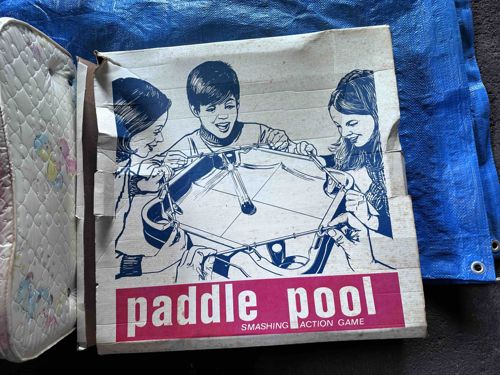
This item is the cardboard box for a vintage game called "Paddle Pool: Smashing Action Game." The box is made of corrugated cardboard, which appears to be a natural, unbleached kraft color, suggesting a utilitarian and likely cost-effective manufacturing process. The primary graphic on the box lid is a two-tone, possibly screen-printed, illustration in blue ink on the natural cardboard background. It depicts three children, two girls and one boy, joyfully engaged in playing the 'Paddle Pool' game, which appears to involve manipulating a central object within a hexagonal or octagonal playing field using rods. The style of the illustration, particularly the children's clothing and hairstyles, strongly suggests a mid to late 20th-century aesthetic, likely the 1960s or 1970s. Below the illustration, the game's title "paddle pool" is prominently displayed in large, sans-serif, white letters against a solid pink or magenta rectangular background. Underneath this, the tagline "SMASHING ACTION GAME" is printed in smaller white letters. The box shows significant signs of wear consistent with age and storage, including creasing, folds, tears, especially along the edges and corners, and general discoloration or dirt accumulation. The top flap, in particular, is heavily creased and appears partially detached or severely bent. There are no visible maker's marks or copyright information immediately discernible from the image, but the overall presentation points to a mass-produced consumer toy item from its era. The simplicity of the graphic design and material choice indicates a focus on function over elaborate presentation, typical of children's games from that period. The condition indicates it has been handled and stored for a long time, possibly without its original contents.
AI Appraisal Report
Upon visual examination of the provided image, I assess this 'Paddle Pool: Smashing Action Game' box for authenticity and condition. The style of the box – utilitarian cardboard, simple two-tone screen-printed graphics, and period-specific illustration (1960s-1970s aesthetics) – is consistent with mass-produced children's games of that era, suggesting it is authentic to its stated period. The condition is poor, showing significant wear, creasing, folds, tears (especially on edges and corners), and discoloration. The top flap appears severely compromised. These are typical signs of age and considerable handling/storage without protective measures. Without the game's contents, the box alone holds limited value.
Regarding market conditions, vintage board games, especially those missing components or in poor condition, typically command low prices unless they are exceedingly rare or culturally iconic. 'Paddle Pool' does not appear to be a highly sought-after or historically significant title. Comparables for incomplete, common vintage games in similar condition often fall into the $10-$30 range. Demand for the box alone, particularly in this state, is very low, primarily limited to niche collectors seeking to complete a set or as a display piece for a highly obscure collection. Rarity is difficult to ascertain from the image alone, but its simple construction suggests it was likely mass-produced.
The primary factor impacting value negatively is the poor condition and the absence of the game itself. If the complete game were present and in better condition, the value would be higher. Limitations in authenticity verification from images alone include the inability to physically inspect the material quality, printing process details, and precise age-related degradation. For full authentication, I would require a physical examination to check paper stock, ink types, internal box structure, and any hidden manufacturer marks. Provenance documentation could also confirm its history.