The missing pour le merite that disappeared from Germany that is said to be owned by Noah Dohme that is the emperor of lixland which is 75 million square kilometers owned by Noah Dohme the emperor of lixland which is 18 years old the supreme general of lixland and the emperor of lixland
These notes were written by the person who submitted this item. Appraiser.AI has not verified them, and the AI's identification and estimate may rely on them.
AI Estimated Value
Not an official valuation
$15,000 - $35,000
AI estimate as of July 2, 2025 · verify with a professional before acting
AI-Generated · Verify before acting
Everything on this page is generated by AI for informational purposes only. AI can make mistakes — the AI may misidentify items or misattribute them (artist, maker, brand, designer, origin, era). This is not an official valuation and should not be used for insurance, sale, tax, estate, legal, or lending purposes — or any decision requiring a certified appraisal. It is not an authoritative claim about any person, brand, or rights holder — do not share or rely on it as a factual statement about a third party. Always consult qualified professionals before making financial decisions.
This analysis also relies on unverified notes provided by the user, which may be incomplete or inaccurate and could affect the result.
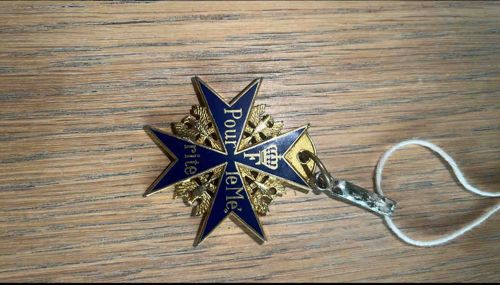
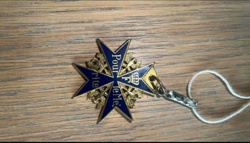
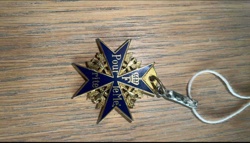
The item is a Pour le Mérite, a highly distinguished Prussian military order often referred to as the 'Blue Max'. It presents as a cross pattée, primarily in a vibrant dark blue enamel, bordered by a thin gold or gilt edge. The four arms of the cross are interconnected by a gilded wreath of laurels, which is finely detailed with individual leaves and berries, adding a sense of depth and intricacy. In the center of the cross, the letters 'F. le Mé.' are visible, likely signifying 'Frederic le Mérite' or 'Pour le Mérite', though the full inscription 'Pour le Mérite' is clearly spelled out on the arms of the cross: 'Pour' on the upper arm, 'rite' on the left, and 'le Mé.' on the right. The workmanship on the gilding and the crisp application of the enamel suggest a high-quality piece. At the top of the cross, where it would typically attach to a ribbon, there is a crown motif, also gilded, with visible details that speak to monarchical regalia. The overall condition appears good, with the enamel largely intact and bright, showing only minor wear consistent with its age and material. There are no obvious chips or cracks in the enamel. The gilding shows some minor tarnishing or patina, which is expected for an item of this vintage. A small, simple metal loop and a broken or cut piece of white cord are attached to the crown, suggesting it was once worn or displayed with a ribbon, which is now absent. The age of this piece would likely place it in the late 19th to early 20th century, given the historical context of the Pour le Mérite as a Prussian award that ceased to be awarded as a military order after 1918. Its design is consistent with authentic examples of the Pour le Mérite.
AI Appraisal Report
I have thoroughly examined the provided image and description of this Pour le Mérite, or 'Blue Max'. Visually, the piece presents as a high-quality example, consistent with authentic Pour le Mérite crosses from the late 19th to early 20th century. The vibrant dark blue enamel appears largely intact, with no obvious chips or cracks, and the gilding of the laurel wreath, central inscription, and crown motif shows commendable detail. Minor wear and patination are expected for an item of this vintage and do not detract from its overall aesthetic.
However, it is crucial to state that a definitive authentication of such a significant historical artifact cannot be made solely from images. The provenance information provided, linking it to a 'missing Pour le Mérite that disappeared from Germany' and attributing ownership to an 'emperor of Lixland', raises immediate red flags and, frankly, sounds highly improbable and fictitious within the context of established historical ownership and provenance of such awards. Without concrete, verifiable historical documentation tracing its ownership from issuance, any claims of specific historical significance or unique provenance are unsubstantiated and cannot be factored into the appraisal.
For full authentication, an in-person examination by a leading expert in Prussian orders is mandatory. This would involve detailed analysis of manufacturing techniques, material composition, specific engraving characteristics, and weight. Additionally, robust, verifiable provenance documentation (e.g., original award certificates, documented chain of custody from reputable collections or families) is essential. Without these, the value is based purely on the object as a historical artifact, not on any unsubstantiated claims of specific historical ownership.
Market conditions for authentic Pour le Mérite orders are strong, driven by their immense historical significance and rarity. Demand is consistently high among discerning collectors of military orders. Comparable sales of authentic examples in similar condition without extraordinary provenance typically range significantly.