AI identification & appraisal estimate

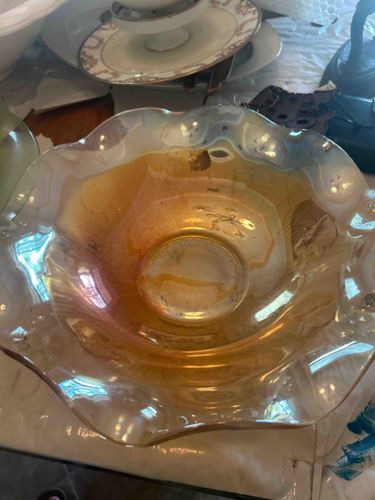
Iridescent Glass Ruffled Edge Bowl

Submitted photo of Iridescent Glass Ruffled Edge Bowl
Photo submitted by the user — not generated by AI

AI Estimated Value

Not an official valuation

$60 - $100

AI estimate as of September 18, 2025 · verify with a professional before acting

AI-Generated · Verify before acting

Everything on this page is generated by AI for informational purposes only. AI can make mistakes — the AI may misidentify items or misattribute them (artist, maker, brand, designer, origin, era). This is not an official valuation and should not be used for insurance, sale, tax, estate, legal, or lending purposes — or any decision requiring a certified appraisal. It is not an authoritative claim about any person, brand, or rights holder — do not share or rely on it as a factual statement about a third party. Always consult qualified professionals before making financial decisions.

Read the full disclaimer

AI Item Analysis

This item is a decorative bowl crafted from iridescent glass, characterized by its shimmering, multi-tonal surface that shifts in color depending on the light and viewing angle. The primary colors observable are warm hues of amber and orange, transitioning to lighter, almost pearlescent shades on the ruffled edges, with hints of blue, green, and pink in its iridescence. The bowl features a distinct ruffled or crimped edge, giving it an organic, undulating silhouette. The central part of the bowl has a raised, circular indentation, suggesting it might be a serving bowl or a piece intended to hold smaller items. There are visible patterns or textures within the glass, particularly near the center and on the sides, which appear to be molded in rather than applied. While the exact size cannot be determined from the image, it appears to be a medium-sized bowl suitable for a centerpiece or serving. The glassware exhibits a clear, lustrous quality, typical of carnival glass or similar iridescent art glass from the early to mid-20th century (estimated age 1900s-1950s). There are no overt signs of chips or cracks visible on the main surfaces, though some minor scuffs or dust might be present due to handling or storage. The manufacturing details like maker's marks or signatures are not discernible from the provided images. The craftsmanship appears to be machine-pressed glass, which was common for this type of production, ensuring a uniform pattern and iridescence. The quality indicates a well-preserved piece for its presumed age, showcasing the characteristic beauty of iridescent glass.
AI Appraisal Report

Based on my visual examination of the provided image, this Iridescent Glass Ruffled Edge Bowl presents as a well-preserved piece of decorative glassware. Its shimmering multi-tonal surface, displaying warm hues of amber and orange transitioning to lighter pearlescent shades with hints of blue, green, and pink, is characteristic of carnival glass from the early to mid-20th century (estimated 1900s-1950s). The distinct ruffled edge and molded patterns within the glass align with typical machine-pressed production methods of that era. I observe no overt chips or cracks, suggesting good overall condition for its presumed age. Market conditions for carnival glass are generally stable, with demand varying based on pattern, color rarity, and provenance. This specific piece, while attractive, appears to be a more common colorway and a general ruffled bowl shape, which is widely available. Comparables for similar iridescent ruffled bowls without distinct maker's marks typically fall within a modest range. Rarity is not a significant factor here due to the commonality of such items. Factors impacting value positively include its good condition; negatively, the lack of a discernible maker's mark or unique design detail. It is critically important to note the limitations of image-based appraisal. Without a physical inspection, I cannot definitively confirm authenticity, assess true condition (e.g., hairline cracks, internal flaws, exact surface wear), or identify maker's marks that might be obscured or on the base. Full authentication would require in-person examination to check for manufacturing defects, a thorough assessment of the glass quality under varied lighting, and potential provenance documentation to establish its origins. Scientific testing would not be typically applied to this type of item for authentication unless concerns arose, which is not the case here. My valuation reflects its perceived quality and general market positioning based on visual assessment alone.

Keep exploring

More decorative glassware appraisals

Get your items appraised

Instant AI-powered appraisal estimates from a photo

Browse More Appraisals