These notes were written by the person who submitted this item. Appraiser.AI has not verified them, and the AI's identification and estimate may rely on them.
AI Estimated Value
Not an official valuation
$30-70
AI estimate as of August 31, 2025 · verify with a professional before acting
AI-Generated · Verify before acting
Everything on this page is generated by AI for informational purposes only. AI can make mistakes — the AI may misidentify items or misattribute them (artist, maker, brand, designer, origin, era). This is not an official valuation and should not be used for insurance, sale, tax, estate, legal, or lending purposes — or any decision requiring a certified appraisal. It is not an authoritative claim about any person, brand, or rights holder — do not share or rely on it as a factual statement about a third party. Always consult qualified professionals before making financial decisions.
This analysis also relies on unverified notes provided by the user, which may be incomplete or inaccurate and could affect the result.
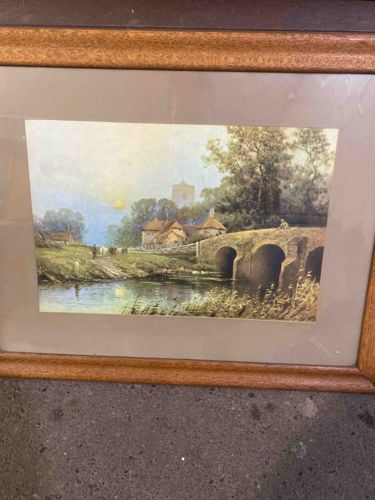
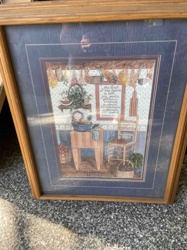
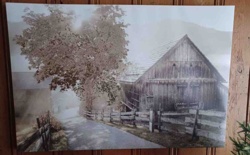
This item is a framed decorative print depicting a pastoral landscape scene typical of early 20th-century European romanticism or academic styles. The print features a prominent three-arch stone bridge crossing a calm river or stream, with rustic thatched-roof cottages nestled on the riverbanks. In the background, a distinctive church or cathedral tower with a square base and pointed roof rises above trees, suggesting a village or town setting. The sky is rendered in soft hues, indicating either sunrise or sunset with a visible yellow glow near the horizon on the left. Scattered figures, possibly people or livestock, are visible on the far bank of the river. The print is housed within a light-brown, possibly oak, wooden frame with a subtle grain pattern and a slightly rounded profile. It appears to have a mat board surrounding the print, which is a neutral, light-beige or taupe color, providing a border between the artwork and the frame. The print itself shows some signs of age, with what appears to be slight discoloration or fading, particularly in the sky area, which could be indicative of exposure to light over time. No specific artist signature or edition details are discernible from the image. The condition of the frame appears relatively good, though dust or minor surface wear might be present. The overall aesthetic suggests a mass-produced decorative item from the mid-to-late 20th century, intended for general home decor.
AI Appraisal Report
After a thorough visual examination of the provided image of this framed landscape print, I conclude that it is a decorative piece, likely mass-produced. The scene, depicting a river, bridge, and village, aligns with early to mid-20th-century romanticized European landscapes, appealing to broad consumer tastes. The condition of the print shows clear signs of age, including noticeable discoloration or fading, particularly in the sky, suggesting prolonged light exposure. This significantly impacts its aesthetic appeal and, consequently, its value. The frame appears to be a standard light-brown wooden type, commensurate with general home decor items of the era, and seems to be in fair condition with minor wear. No artist signature or edition details are visible, reinforcing its likely mass-produced nature rather than an fine art print.
In terms of market conditions, decorative prints of this age and style, lacking specific provenance, artist attribution, or limited edition status, typically occupy the lower end of the art market. Comparables for such items are found in thrift stores, estate sales, and online marketplaces, where prices generally range from nominal to modest. Demand for generic nostalgic landscape prints is stable but not high, and rarity is not a factor here given the likely production volume.
The primary factor significantly impacting value is the condition (fading) and the absence of any unique attributes, such as artist, date, or limited edition number. Without physical inspection, I cannot confirm the printing technique (e.g., lithograph, photogravure) or fully assess the extent of discoloration, which impacts restoration potential. Authenticating an artist's original work or identifying a specific print series would require in-person examination to check for watermarks, paper quality, printing process details, and ideally, provenance documentation. Scientific testing (e.g., pigment analysis) would be needed for absolute verification, though it's typically not warranted for items in this value range. Based on current condition and market for similar decorative vintage prints, I would appraise this item in the range of $30-70.