These notes were written by the person who submitted this item. Appraiser.AI has not verified them, and the AI's identification and estimate may rely on them.
AI Estimated Value
Not an official valuation
$200-300
AI estimate as of September 2, 2025 · verify with a professional before acting
AI-Generated · Verify before acting
Everything on this page is generated by AI for informational purposes only. AI can make mistakes — the AI may misidentify items or misattribute them (artist, maker, brand, designer, origin, era). This is not an official valuation and should not be used for insurance, sale, tax, estate, legal, or lending purposes — or any decision requiring a certified appraisal. It is not an authoritative claim about any person, brand, or rights holder — do not share or rely on it as a factual statement about a third party. Always consult qualified professionals before making financial decisions.
This analysis also relies on unverified notes provided by the user, which may be incomplete or inaccurate and could affect the result.
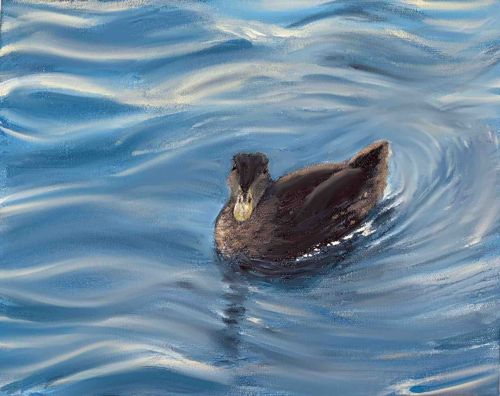
This is an acrylic painting on an 8" x 10" canvas by the artist Mary Chesney, depicting a single duck swimming in water. The dominant colors are various shades of blue for the water, ranging from a lighter sky blue to deeper indigo tones, with white and light blue brushstrokes effectively conveying the movement and ripples of the water. The duck is rendered in shades of brown and dark grey, with subtle highlights that suggest texture on its feathers. Its beak is a lighter, yellowish color, providing a small point of contrast on an otherwise dark head. The duck appears to be a common domestic duck or possibly a mallard hen due to its coloring. The brushwork in the water exhibits a dynamic quality, creating a sense of motion and reflecting light effectively. The painting shows strong craftsmanship in its ability to capture the liquidity of water and the solitary presence of the duck. There are no visible condition issues such as wear, damage, or repairs discernable from the image; the paint appears fresh and vibrant. The style is representational, with an impressionistic quality in the rendering of the water. Given the provided context, the painting is contemporary, likely from recent years, as it's a piece by Mary Chesney. The proportions and perspective are well-executed, placing the duck centrally in the frame, creating a focused and serene composition. The overall quality suggests a competent and skilled artist.
AI Appraisal Report
Based on my visual examination of the provided image, this acrylic painting on an 8” x 10” canvas, titled “Duck in Water” by Mary Chesney, appears to be in excellent condition. The colors are vibrant, and there are no visible signs of wear, damage, or repairs. The brushwork effectively captures the movement and liquidity of water and the texture of the duck's feathers, indicating a competent artist. This representational style, with an impressionistic quality in the water's rendering, is generally appealing.
Regarding market conditions, small-format acrylic paintings by emerging or less established artists like Mary Chesney typically command modest prices. While the subject matter is classic and timeless, appealing to a broad audience, the smaller size and lack of extensive provenance or exhibition history keep the value within a certain range. Comparable sales for similar works by contemporary regional artists of this scale generally fall in the low to mid-hundreds.
Demand for original art depicting wildlife, particularly ducks, is consistently present, but the supply from numerous artists is also high, reducing rarity. The primary factors influencing value here are the artist's skill, the painting's pleasing aesthetic, and its pristine condition.
It is important to note the limitations of appraising solely from images. While the painting appears authentic to the description, definitive authentication of the artist's signature (if present), the specific medium, and the canvas origin would require an in-person examination. Full provenance documentation, such as receipts or exhibition histories, would further confirm authenticity and could marginally impact value. Scientific testing for paint composition or age dating is not typically cost-effective or necessary for works of this estimated value but would offer absolute confirmation if required.