AI Appraisal Estimate

AI-generated estimates · not official valuations

From the user

What was submitted

Photo and notes provided by the user — not generated by AI

Submitted item photo
Submitted photo · June 6, 2026

User's notes

No additional notes provided.

AI analysis below

AI appraisal

AI analysis & estimate

AI-Generated · Verify before acting

Everything below is generated by AI for informational purposes only. AI can make mistakes — the AI may misidentify items or misattribute them (artist, maker, brand, designer, origin, era). This is not an official valuation and should not be used for insurance, sale, tax, estate, legal, or lending purposes — or any decision requiring a certified appraisal. It is not an authoritative claim about any person, brand, or rights holder — do not share or rely on it as a factual statement about a third party. Always consult qualified professionals before making financial decisions.

Read the full disclaimer

AI Identification

·Not independently authenticated·Verify before acting

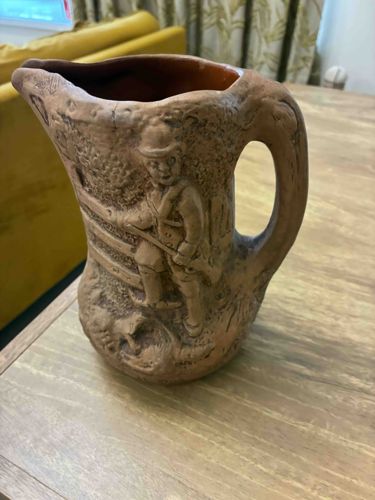
Relief-Decorated Terracotta Tavern or Hunting Scene Pitcher

Decorative Ceramics / Folk Art

AI Estimated Value

·Not an official valuation·Verify before acting

$45 - $75

As of June 6, 2026

AI Item Analysis

·AI can make mistakes·Verify before acting
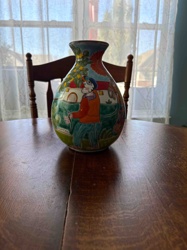
This is a rustic, hand-built or mold-pressed terracotta ceramic pitcher featuring a high-relief figural scene. The central motif depicts a gentleman in 18th or 19th-century attire, wearing a wide-brimmed bowler-style hat and carrying a long rifle or walking stick, standing adjacent to a split-rail fence. The background is heavily textured with stippled and bark-like patterns, extending to the thick, curved handle which mimics the appearance of a gnarled tree branch. The interior of the pitcher appears glazed in a darker brown tone, while the exterior maintains a matte, unglazed or lightly washed earthy red-orange finish. This style is often associated with the mid-20th century revival of 19th-century 'parian' or 'stoneware' relief styles. In terms of condition, there is visible cracking along the upper rim near the spout, and the surface shows general wear, dust accumulation in the crevices of the relief, and some minor abrasions consistent with age. There are no visible maker's marks in this view, but the craftsmanship suggests a folk-art or decorative commercial production focused on rural or sporting themes. The overall aesthetic is one of deliberate 'primitivism' intended to evoke a historical, pastoral feel.
AI Appraisal Report

·AI can make mistakes·Verify before acting
I have conducted a visual inspection of the Relief-Decorated Terracotta Pitcher through high-resolution photography. The item displays a central narrative relief of a hunter or traveler, set against a bark-patterned texture. While the figural work attempts a 19th-century stoneware aesthetic, the sharpness of the mold and the specific coloration of the terracotta suggest this is a mid-20th-century decorative production, likely from a European or American commercial pottery specializing in 'lodge-style' or rustic revival wares. Condition is a significant factor in this valuation. I noted visible structural cracking along the upper rim and spout, along with surface abrasions and deep-seated dust in the stippled recesses. These defects, common in low-fired terracotta, detract from the piece's utility and aesthetic appeal. In the current market, decorative relief-ware of this era and material is relatively common, often seen in estate sales and regional auctions. It lacks the rarity of signed 19th-century salt-glazed stoneware or unique folk-art pottery from documented masters. A definitive authentication of age and origin is limited by the digital format. To provide a conclusive valuation, an in-person examination is required to check for hidden maker's marks on the base, analyze the specific composition of the glaze inside the vessel, and assess the depth of the rim cracks to determine structural stability. Provenance documentation regarding its original purchase point would further clarify its origin. Scientific testing—specifically thermoluminescence (TL) dating—could be used to verify the firing date if its antiquity were in question, though the current estimate does not justify such costs.

Get your items appraised

Instant estimates of your treasures with AI-powered appraisals

Browse More Appraisals