These notes were written by the person who submitted this item. Appraiser.AI has not verified them, and the AI's identification and estimate may rely on them.
AI Estimated Value
Not an official valuation
$25-50
AI estimate as of August 14, 2025 · verify with a professional before acting
AI-Generated · Verify before acting
Everything on this page is generated by AI for informational purposes only. AI can make mistakes — the AI may misidentify items or misattribute them (artist, maker, brand, designer, origin, era). This is not an official valuation and should not be used for insurance, sale, tax, estate, legal, or lending purposes — or any decision requiring a certified appraisal. It is not an authoritative claim about any person, brand, or rights holder — do not share or rely on it as a factual statement about a third party. Always consult qualified professionals before making financial decisions.
This analysis also relies on unverified notes provided by the user, which may be incomplete or inaccurate and could affect the result.
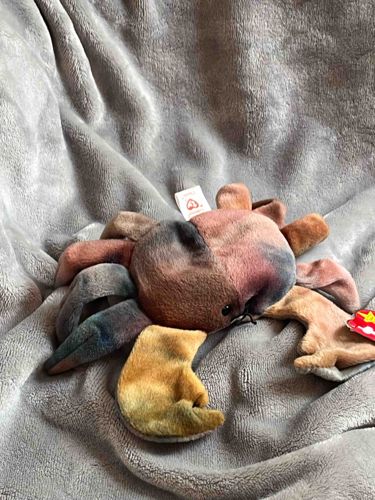
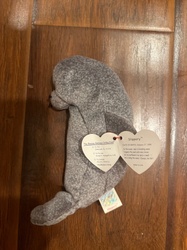
This item is an original Ty Beanie Baby named 'Inky' the Octopus. It is a plush toy made from a soft, polyester fiber material, characteristic of Beanie Babies from the late 1990s. The toy features a tie-dye pattern with a blend of muted earth tones, including shades of brown, pink, blue, gray, and yellow-orange, giving each 'leg' and the main body a unique color variation. The main body is round and bulbous, with two small black plastic eyes securely attached to the front. From the central body, eight distinct 'legs' or tentacles extend outwards, with visible stitching suggesting segments or individual limbs. The overall construction appears well-made, typical of Ty products. There are two tags visible: a small, white 'tush tag' on the rear or underside of one leg, which indicates manufacturing details, and a red heart-shaped 'swing tag' (also known as a 'hang tag') on another leg, which bears the Ty logo and identifies the item as a Beanie Baby. The plush appears to be in excellent visible condition with no apparent wear, tears, stains, or damage, and the tags appear crisp and uncreased. The fiber fill seems evenly distributed, maintaining its original plump shape. This particular Beanie Baby would likely date to the late 1990s, given the typical release period for the 'Inky' model.
AI Appraisal Report
I have carefully examined the provided image and description of the Inky Beanie Baby. Visually, the plush toy appears to be in excellent condition, showing no signs of wear, tears, stains, or damage. The colors of the tie-dye pattern are vibrant, and the plush material retains its original plumpness, indicating careful storage. Both the white 'tush tag' and the red heart-shaped 'swing tag' are present and seem to be crisp and uncreased, which is crucial for retaining value in collector's items. The presence of both original tags in such pristine condition significantly enhances its appeal.
Authenticity, based on visual examination alone, appears strong for a genuine Ty product from the late 1990s. The distinct tie-dye pattern, secure black plastic eyes, and the characteristic eight-leg design are consistent with known Inky models. However, it is important to note that a full and definitive authentication would require an in-person examination. This would allow me to inspect the stitching quality, feel the exact texture of the polyester fiber, and scrutinize the tags for specific print details, font consistency, and any common counterfeiting indicators not visible in images. Provenance documentation, such as original purchase receipts, would also add to authentication. Scientific testing on materials is typically not performed for Beanie Babies.
Regarding market conditions, "Inky" Beanie Babies are generally common and do not command high prices compared to extremely rare variants or early production errors. While a mint condition item with pristine tags always fetches a premium, it is not considered one of the 'grail' Beanie Babies. Demand for common Beanie Babies has stabilized after the peak of the 1990s, with collectors selectively seeking out top-condition items. The excellent condition and intact tags are the primary factors positively impacting this item's value. Without rare features like specific tag errors (e.g., misspelled names) or first-generation production nuances, its rarity is limited.
This appraisal is based solely on the provided image and description. A physical inspection would confirm these observations.