AI Appraisal Estimate

AI-generated estimates · not official valuations

From the user

What was submitted

Photo and notes provided by the user — not generated by AI

Submitted item photo
Submitted photo · June 18, 2026

User's notes

No additional notes provided.

AI analysis below

AI appraisal

AI analysis & estimate

AI-Generated · Verify before acting

Everything below is generated by AI for informational purposes only. AI can make mistakes — the AI may misidentify items or misattribute them (artist, maker, brand, designer, origin, era). This is not an official valuation and should not be used for insurance, sale, tax, estate, legal, or lending purposes — or any decision requiring a certified appraisal. It is not an authoritative claim about any person, brand, or rights holder — do not share or rely on it as a factual statement about a third party. Always consult qualified professionals before making financial decisions.

Read the full disclaimer

AI Identification

·Not independently authenticated·Verify before acting

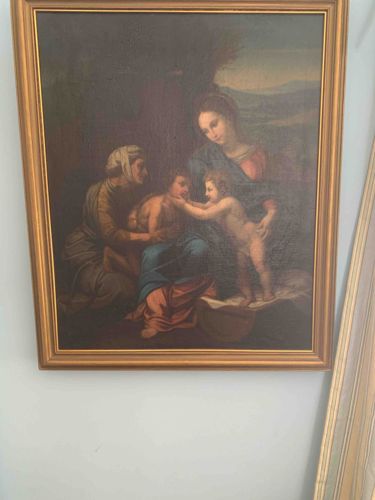
Madonna of the Divine Love (After Raphael)

Fine Art - Paintings

AI Estimated Value

·Not an official valuation·Verify before acting

$2,500 - $4,000

As of June 18, 2026

AI Item Analysis

·AI can make mistakes·Verify before acting
This item is an oil-on-canvas or oil-on-panel painting depicting the 'Madonna of the Divine Love', a composition originally attributed to the High Renaissance master Raphael. The scene features the Virgin Mary and Saint Elizabeth with the infant Jesus and Saint John the Baptist in a lush landscape setting. The figures are arranged in a classical pyramidal composition, with Saint Elizabeth on the left and the Madonna dominating the center-right. The color palette is composed of rich, traditional Renaissance hues including lapis-like blues, deep crimson, and earthy umbers. The painting is housed in a modern, tiered goldleaf-finish wooden frame with a beaded inner edge. Regarding condition, the surface exhibits significant darkening of the varnish, which has yellowed over time, obscuring some of the finer details in the background and drapery. There is visible craquelure across the surface consistent with an aged oil medium, particularly in the lighter flesh tones. No immediate signatures or maker's marks are visible on the front, suggesting it may be a 19th-century or early 20th-century academic copy or an older devotional work after the original masterpiece. The smooth blending of shadows (sfumato) and the soft anatomical rendering indicate a high level of technical skill in reproducing the original's aesthetic. However, the overall dimness of the work suggests it would benefit from professional conservation and cleaning.

AI Appraisal Report

·AI can make mistakes·Verify before acting
Based on my examination of this oil-on-panel execution of the 'Madonna of the Divine Love,' I have assessed the work as a high-quality 19th-century academic copy after the original composition by Raphael. The painting demonstrates proficient technical skill, particularly in the soft sfumato of the flesh tones and the classical pyramidal arrangement. The condition is fair to good; while the structural integrity appears sound, the presence of heavy, yellowed varnish and surface grime significantly obscures the original pigment vibrancy and background depth. The fine craquelure visible in the lighter passages is consistent with age and indicates a natural drying process of the oil medium. Market demand for Old Master copies remains steady among traditional collectors, though values are heavily influenced by the level of execution and the state of conservation. Comparables for unsigned 19th-century copies of this caliber typically range from $2,000 to $5,000 at auction. The modern goldleaf-finish frame adds decorative appeal but lacks historical value. The current appraisal accounts for the necessary cost of professional cleaning and varnish removal. Limitations: This assessment is based on photographic evidence alone. A definitive dating and attribution are impossible without physical inspection. To confirm the age of the substrate and pigments, an in-person examination under UV light and potentially X-ray fluorescence (XRF) or infrared reflectography would be required to rule out later synthetic pigments and to examine the underdrawing. Provenance documentation, such as previous sales records or exhibition history, would be essential to elevate the work's market standing beyond that of a high-quality decorative copy.

Get your items appraised

Instant estimates of your treasures with AI-powered appraisals

Browse More Appraisals