These notes were written by the person who submitted this item. Appraiser.AI has not verified them, and the AI's identification and estimate may rely on them.
AI Estimated Value
Not an official valuation
$300-500
AI estimate as of November 30, 2025 · verify with a professional before acting
AI-Generated · Verify before acting
Everything on this page is generated by AI for informational purposes only. AI can make mistakes — the AI may misidentify items or misattribute them (artist, maker, brand, designer, origin, era). This is not an official valuation and should not be used for insurance, sale, tax, estate, legal, or lending purposes — or any decision requiring a certified appraisal. It is not an authoritative claim about any person, brand, or rights holder — do not share or rely on it as a factual statement about a third party. Always consult qualified professionals before making financial decisions.
This analysis also relies on unverified notes provided by the user, which may be incomplete or inaccurate and could affect the result.
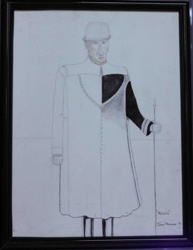
This is a framed artwork executed in a sanguine (red chalk) monochrome style, depicting a plump male figure seated at a table. The figure, dressed in a hat, jacket, and trousers, is characterized by the exaggerated, voluminous forms typical of Fernando Botero's style, an aesthetic known as 'Boterismo'. He is shown engaged in what appears to be the peeling of a small fruit or vegetable, holding a knife in one hand and the item in the other, with peelings visible on the table. The setting is an interior scene looking out onto a village landscape with tiled roofs, a church steeple, and distant mountains under a cloudy or overcast sky. A draped curtain is visible on the left side of the composition. The artwork is contained within an ornate, dark-toned (likely black or very dark brown) wooden frame featuring intricate, possibly carved or molded, scrollwork and floral motifs. The signature 'F. Botero 11' is visible in the lower right corner, suggesting an attribution to Fernando Botero and a creation year of 2011. While the style strongly emulates Botero's distinct aesthetic, further authentication would be required to confirm it as an original work by the renowned artist. The overall condition appears good, with no obvious signs of major damage, fading, or material degradation visible within the frame. The frame itself shows some minor wear consistent with handling but maintains its structural integrity and decorative appeal. The monochromatic palette emphasizes form and shadow, highlighting the three-dimensional quality of the 'Botero' style figures.
AI Appraisal Report
Based on my visual examination of the 'Figural Study in Sanguine Monochrome (style of Botero)', the artwork appears to be in good overall condition. The sanguine drawing technique beautifully renders the voluminous forms characteristic of Fernando Botero's style, with effective use of shadow to emphasize three-dimensionality. The ornate, dark wooden frame is also in good condition, showing only minor wear consistent with handling, and structurally sound. The signature 'F. Botero 11' is visible, strongly suggesting a direct attribution. However, this is where a critical distinction must be made regarding authenticity.
While the style is highly evocative of Botero, and the signature present, verifying its authenticity solely from an image is impossible. The market for genuine Fernando Botero drawings, especially signed ones, commands values in the tens to hundreds of thousands of dollars, depending on size, subject, and complexity. This piece, while aesthetically pleasing and skillfully executed in his style, presents several red flags for an original work when considering typical market comparables and known fakes.
Therefore, without in-person examination to assess the paper, pigment, and line quality, and crucially, without comprehensive provenance documentation (bills of sale, exhibition history, certificates of authenticity from a recognized Botero expert or the artist's estate), I must appraise this piece as a decorative artwork *in the style of Botero*, rather than an authenticated original. Scientific testing of the materials could also provide insights. The significant difference in value reflects this. As a decorative piece, the demand is moderate, driven by its attractive Botero-esque qualities and appealing setting. Its rarity as an *authenticated original* is currently unestablished here. For these reasons, my appraisal value accounts for its decorative appeal and execution, but not the premium of a verified masterwork.