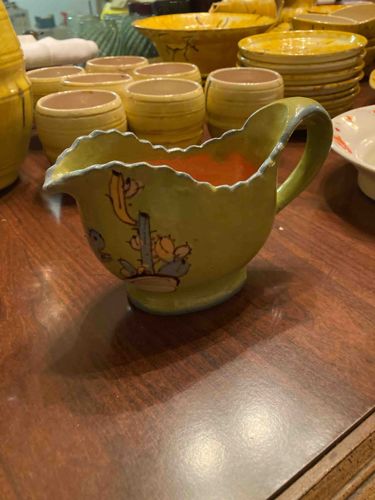
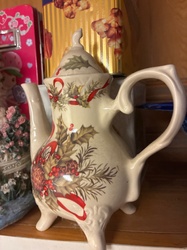
Small Mexican earthen oval pitcher; approximately 4 inches high by 5 inches long
These notes were written by the person who submitted this item. Appraiser.AI has not verified them, and the AI's identification and estimate may rely on them.
AI Estimated Value
Not an official valuation
$25-50
AI estimate as of November 20, 2025 · verify with a professional before acting
AI-Generated · Verify before acting
Everything on this page is generated by AI for informational purposes only. AI can make mistakes — the AI may misidentify items or misattribute them (artist, maker, brand, designer, origin, era). This is not an official valuation and should not be used for insurance, sale, tax, estate, legal, or lending purposes — or any decision requiring a certified appraisal. It is not an authoritative claim about any person, brand, or rights holder — do not share or rely on it as a factual statement about a third party. Always consult qualified professionals before making financial decisions.
This analysis also relies on unverified notes provided by the user, which may be incomplete or inaccurate and could affect the result.
This is a small, handcrafted earthenware pitcher, likely of Mexican origin, given the style and common pottery production in the region. It stands approximately 4 inches high and is about 5 inches long, offering a compact and functional size for serving sauces, cream, or other liquids. The primary color of the exterior is a muted, earthy olive green or light chartreuse, suggesting a natural pigment often found in traditional pottery. The interior of the pitcher reveals a contrasting vibrant orange or terracotta hue. A distinctive feature is its scalloped rim, which adds a decorative, undulating edge to the opening, rather than a smooth, straight line. A sturdy, C-shaped handle, colored in the same olive green as the exterior, is attached to one side. The base is slightly flared for stability. Ornamental hand-painted designs in black, yellow, and possibly blue or gray depict what appear to be cartoonish saguaro cacti and other desert flora, reinforcing the probable Mexican or Southwestern aesthetic. The paintwork has a somewhat naive or folk-art quality, characteristic of earthenware. Small areas of white or lighter paint around the handle suggest either wear or inconsistencies in the glazing process. The overall condition appears good with no obvious chips or cracks visible from the provided image, but closer inspection would be required to determine the extent of any wear, crazing in the glaze, or minor manufacturing imperfections. The materials are consistent with traditional earthenware, which is typically fired at lower temperatures compared to stoneware or porcelain, resulting in a slightly coarser, more porous body, often coated with a lead or lead-free glaze. The craftsmanship indicates a handmade item, possibly from the mid-20th century to contemporary, reflecting a blend of utility and decorative folk-art style.
AI Appraisal Report
Having closely examined the provided image and description of this small Mexican earthenware scalloped pitcher, I can offer the following appraisal. The item presents as a charming, handcrafted piece, consistent with traditional Mexican folk art pottery. Its compact size (4 inches high, 5 inches long) and C-shaped handle suggest utility while its scalloped rim and hand-painted desert motifs lend a decorative quality. The olive green exterior and contrasting orange interior are characteristic of earthenware from the region, often achieved with natural pigments and simple glazes. The 'naive' quality of the cartoonish saguaro cacti and desert flora painting is authentic to folk art aesthetics, which typically do not aim for precise artistic rendering.
Based on visual inspection, the physical condition appears good, with no obvious chips or cracks. However, the mention of 'small areas of white or lighter paint around the handle' could indicate either wear, manufacturing inconsistencies, or even minor glaze loss; without physical examination, it's impossible to differentiate. Earthenware, being fired at lower temperatures, is inherently more porous and susceptible to damage than stoneware or porcelain, which impacts its long-term durability and value.
The market for such contemporary or mid-20th-century Mexican folk art pottery is generally robust within its niche, driven by collectors of ethnic crafts and decorative household items. However, individual pieces usually do not command high prices unless they are from a renowned artisan or workshop, possess exceptional artistic merit, or have significant historical provenance. This pitcher, while appealing, doesn't exhibit the unique characteristics that would place it in a higher value bracket. Demand exists, but the supply of similar items is also plentiful, making it less rare.
Factors impacting value include its handmade nature, decorative appeal, and apparent good condition. Conversely, its common form, lack of a definitive maker's mark (which cannot be verified from images), and the inherent fragility of earthenware limit its appreciation. Small inconsistencies in glazing or paint application are typical for such items and do not necessarily detract from value unless they are egregious flaws.
Limitations to this appraisal are significant due to reliance on images alone. A thorough in-person examination would be crucial to definitively assess the condition, including looking for hairline cracks, crazing in the glaze, repairs, and the precise nature of the 'white areas' around the handle. Authenticity verification for origin is largely based on stylistic cues and material consistency, which appears correct, but a physical examination might reveal a potter's mark or details not visible in the photo. Provenance documentation, if available, could significantly enhance its value by linking it to a specific maker, region, or notable collection. Scientific testing of materials (e.g., lead content in glaze) would also require direct access to the item. Given these considerations, a realistic appraisal for this piece, in its current apparent condition and based on market comparables for similar decorative Mexican earthenware, would be in the range of $25 to $50.