AI estimate as of December 13, 2025 · verify with a professional before acting
AI-Generated · Verify before acting
Everything on this page is generated by AI for informational purposes only. AI can make mistakes — the AI may misidentify items or misattribute them (artist, maker, brand, designer, origin, era). This is not an official valuation and should not be used for insurance, sale, tax, estate, legal, or lending purposes — or any decision requiring a certified appraisal. It is not an authoritative claim about any person, brand, or rights holder — do not share or rely on it as a factual statement about a third party. Always consult qualified professionals before making financial decisions.
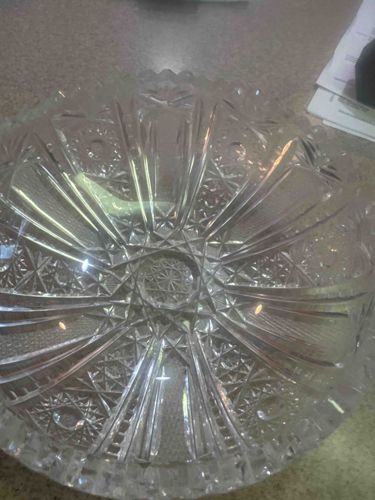
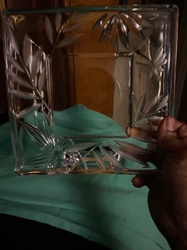
This item is a decorative cut glass bowl, likely made of crystal due to its impressive brilliance and intricate facets. The color is clear and colorless, showcasing the material's purity. It is circular in form with a scalloped or sawtooth rim, a common feature in cut glass dinnerware. The bowl features an elaborate and deeply cut pattern, characteristic of the 'Brilliant Cut Glass' style, which was popular during the late 19th and early 20th centuries. The pattern consists of a central starburst or hobstar design from which radiating panels with geometric cuts extend towards the rim. These panels incorporate a variety of motifs such as cross-hatching, small hobstars, and fan cuts, creating a highly reflective and sparkling surface. The construction appears to be solid and well-executed, with sharp angles and clean lines indicative of skilled craftsmanship. No visible manufacturing marks or signatures are discernible from the provided images. The overall condition appears good, with no obvious chips, cracks, or significant damage. A slight patina or minor surface wear might be present consistent with its estimated age, which could be from the late 1800s to the 1930s. The thickness and weight, though not directly observable from the image, are typically substantial in such pieces, contributing to their impressive presence.
AI Appraisal Report
Based on my visual examination of the provided image, this decorative cut glass bowl is a commendable example of early 20th-century glassware, likely crystal, showcasing the 'Brilliant Cut Glass' style. The clear, colorless material, intricate facets, central hobstar, and radiating geometric panels with cross-hatching and fan cuts are characteristic of the period. The scalloped rim adds a classic touch. Its apparent good condition, with no obvious chips or cracks, bodes well for its value. Minor surface wear consistent with age is expected and does not significantly detract.
Authenticity, based purely on visual assessment, suggests it is a genuine piece from the late 1800s to 1930s. The quality of the cutting appears high, indicating skilled craftsmanship. In terms of market conditions, while Brilliant Cut Glass was once highly sought after, demand has moderated. However, well-preserved pieces with complex patterns like this one still attract collectors. Comparables on the secondary market for similar bowls typically range from $80 to $300, depending on the complexity of the cut, size, and specific maker if identifiable. Its intricate design elevates it above more common patterns. Rarity is moderate; many such bowls were produced, but finding one in excellent condition is becoming less common.
Factors significantly impacting value include its condition, the intricacy and sharpness of the cut, and the absence of damage. The lack of visible manufacturing marks or signatures is a limitation that prevents immediate attribution to a specific, highly collectible maker. For full authentication and to ascertain the exact maker and verify material composition (lead crystal vs. soda-lime glass), a physical in-person examination would be crucial. This would involve inspecting the base for minute etchings, assessing the weight and resonance (a property of lead crystal), and potentially undertaking scientific testing for material analysis. Without these, my authentication is limited to visual characteristics.