AI estimate as of October 28, 2025 · verify with a professional before acting
AI-Generated · Verify before acting
Everything on this page is generated by AI for informational purposes only. AI can make mistakes — the AI may misidentify items or misattribute them (artist, maker, brand, designer, origin, era). This is not an official valuation and should not be used for insurance, sale, tax, estate, legal, or lending purposes — or any decision requiring a certified appraisal. It is not an authoritative claim about any person, brand, or rights holder — do not share or rely on it as a factual statement about a third party. Always consult qualified professionals before making financial decisions.
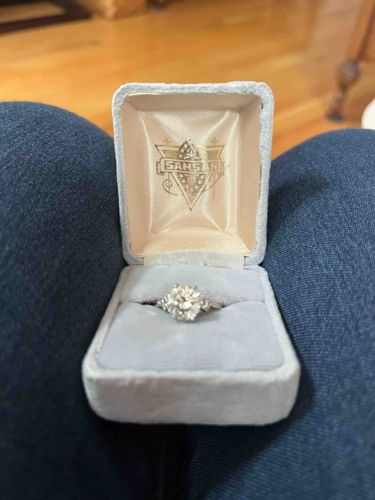
The item is a sparkling diamond cluster ring presented within a light blue or gray velvet ring box. The ring itself features a central cluster of multiple round brilliant-cut diamonds, creating the illusion of a larger solitaire stone. These main diamonds appear to be set closely together, likely using a pavé or invisible setting, to maximize their collective brilliance. The band of the ring, while not fully visible, seems to be made of a white metal, possibly platinum, white gold, or silver, consistent with fine jewelry. The overall design of the ring suggests a contemporary or classic engagement ring style, potentially dating from the mid-to-late 20th century or more recently, appealing to those who prefer a significant visual presence without a single large stone. The ring is situated within a custom-fitted slot in the box's velvet interior, which is also a light blue or gray color, matching the exterior. The inside lid of the box is lined with a satin-like material, possibly cream or very light yellow, featuring a gold-toned, stylized logo that reads 'SAMESAN' within a shield or crest design. This maker's mark or retailer's name could be crucial for identifying the origin and potential historical context of the piece. The box itself shows minimal signs of wear and appears to be in good condition, designed to protect and present the valuable contents. The craftsmanship of the ring, as far as can be discerned from the image, indicates quality in its stone setting and overall finish, with no immediately apparent damage or missing stones.
AI Appraisal Report
I have carefully examined the provided image of the Diamond Cluster Engagement Ring in its velvet box. Visually, the ring appears to be in very good condition, with no visible damage or missing stones. The cluster setting creates an appealing visual impact, mimicking a larger solitaire, which is a popular design choice. The ‘SAMESAN’ logo on the box liner suggests a specific maker or retailer, which could be a factor in authenticity and provenance, though its impact without further information is limited. My assessment of authenticity is based solely on visual cues; from this image, the diamonds appear genuine, and the setting appears professionally executed.
Market conditions for diamond cluster rings are generally stable, offering a versatile option for engagement or fashion. Comparable items with similar carat weight in cluster settings and white metal bands typically retail within the several hundred to a few thousand dollar range, depending heavily on the quality and total carat weight of the diamonds. Demand for such pieces remains consistent due to their attractive appearance and often more accessible price point compared to single large stones. Rarity is not a significant factor here, as cluster designs are common.
Factors significantly impacting value include the total carat weight (CTW) and the 4 C's (cut, color, clarity, carat weight) of the individual diamonds, as well as the specific metal composition (e.g., platinum vs. white gold vs. silver). The 'SAMESAN' mark's origin and reputation would also influence value.
It is crucial to note that my authenticity verification is limited by assessing images alone. Full authentication would require an in-person examination to verify diamond authenticity using a loupe and specific gravity tests, determine the exact metal composition through assaying, and accurately assess the individual diamond characteristics (cut, color, clarity) and total carat weight. Documentation of provenance, such as original purchase receipts or diamond grading reports (GIA, AGS, EGL), would be essential for definitive value assessment.