AI estimate as of June 25, 2025 · verify with a professional before acting
AI-Generated · Verify before acting
Everything on this page is generated by AI for informational purposes only. AI can make mistakes — the AI may misidentify items or misattribute them (artist, maker, brand, designer, origin, era). This is not an official valuation and should not be used for insurance, sale, tax, estate, legal, or lending purposes — or any decision requiring a certified appraisal. It is not an authoritative claim about any person, brand, or rights holder — do not share or rely on it as a factual statement about a third party. Always consult qualified professionals before making financial decisions.
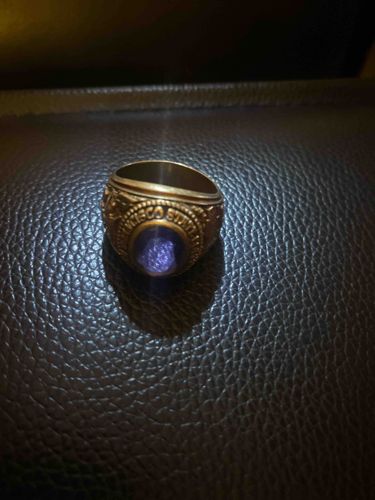
This item is a gold-toned class ring, likely a college or university ring given its substantial size and ornate detailing. The ring features a prominent central oval-shaped stone, which appears to be dark purple or blue, exhibiting a slightly mottled or textured surface, suggesting it might be a synthetic stone or a specific natural variety like a sapphire or amethyst, though its exact composition is undeterminable from the image. The setting for the stone is a bezel-like design. The shoulders and bezel of the ring are highly decorated with raised, intricate patterns and text. On one side of the bezel, the word "WECCA" or "WESCA" is partially visible in raised lettering, curving around the central gem. This lettering, along with other unidentifiable ornate motifs on the ring's shoulders, suggests an institutional affiliation or specific year. The metal appears to be a polished gold or gold-plated material, and while there's superficial wear consistent with frequent use, there are no visible major damages like dents, cracks, or significant abrasions. The craftsmanship appears to be robust, indicating a durable piece of jewelry often worn daily. The ring exhibits a classic class ring design, likely from the late 20th or early 21st century, given its style and level of detail. Its overall condition is good with a visible patina that has developed over time.
AI Appraisal Report
Based on my visual examination of the provided image, this gold-toned class ring with a purple stone appears to be in good overall condition, exhibiting superficial wear consistent with its likely use over time. The craftsmanship seems robust, suggesting a durable piece. While the metal has the appearance of gold or gold-plating, its exact composition cannot be determined without physical inspection or material testing. The central stone is possibly synthetic given its mottled appearance, or it could be a natural variety like sapphire or amethyst; a definitive identification would require gemological assessment. The visible "WECCA" or "WESCA" text points to an institutional affiliation, which is common for class rings. The classic design suggests a late 20th or early 21st-century origin.
Authenticity verification from images alone has limitations. I cannot confirm the metal purity (e.g., 10K, 14K gold, or gold-plated base metal) or the stone's nature (natural vs. synthetic, specific gem type). An in-person examination would allow for precise material testing, weight measurement, and closer inspection of hallmarks or engravings for institutional identification, which significantly impacts value. Provenance documentation, such as original purchase receipts or letters of authenticity from the issuing institution, would also be invaluable.
Market conditions for class rings are largely driven by material value, the prestige of the issuing institution, and condition. While there is a niche market for vintage class rings, especially those from historically significant universities or with desirable designs, general demand for specific individual class rings is moderate unless they possess high precious metal content. Rarity is low as such rings are mass-produced for graduating classes. The value is primarily sentimental for the original owner. Without knowing the metal composition, the institution, or the stone type, valuation is speculative. If it were solid gold, the value would be tied to its gold weight; if gold-plated, its value is significantly lower.
Factors significantly impacting value include the actual metal (solid gold vs. plated), the type and quality of the stone, and the specific institution represented. Without these details, the intrinsic material value cannot be accurately assessed. Assuming it is gold-plated with a synthetic stone, its value is mainly decorative or sentimental.