AI estimate as of October 23, 2025 · verify with a professional before acting
AI-Generated · Verify before acting
Everything on this page is generated by AI for informational purposes only. AI can make mistakes — the AI may misidentify items or misattribute them (artist, maker, brand, designer, origin, era). This is not an official valuation and should not be used for insurance, sale, tax, estate, legal, or lending purposes — or any decision requiring a certified appraisal. It is not an authoritative claim about any person, brand, or rights holder — do not share or rely on it as a factual statement about a third party. Always consult qualified professionals before making financial decisions.
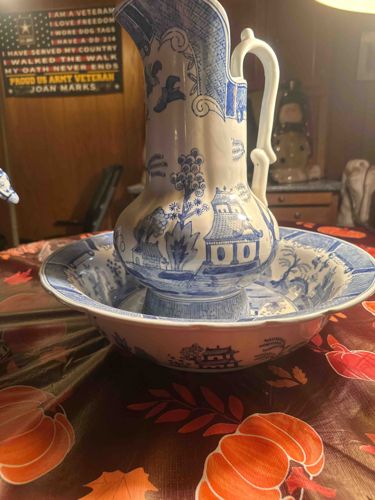
This item is a traditional pitcher and basin set, typically used for washing. The set comprises a large pitcher with a handle and a wide-brimmed basin, both crafted from ceramic, likely porcelain or earthenware, exhibiting a classic blue and white transferware decoration. The predominant colors are a vivid cobalt blue against a creamy white background. The pattern, often referred to as Chinoiserie or Willow-ware style, features intricate depictions of pagodas, bridges, trees (including what appear to be willow and other leafy varieties), mountainous or hilly landscapes, and possibly birds or other small figures, all rendered in fine detail through the transfer printing process. The pitcher has a graceful, bulbous body that tapers upwards to a flaring rim with a pouring spout. Its handle is a delicate, scrolling design with some decorative articulation at the points where it joins the body. The basin is wide and relatively shallow, designed to catch water, with its rim showing subtle fluting or scalloping. The base of the pitcher prominently features a large pagoda structure with multiple roofs and surrounding landscape elements. The interior and exterior of the basin also display complementary scenes from the same pattern. The craftsmanship appears to be of good quality, with clear, crisp transfer print application and a smooth, glossy glaze. There are no immediately visible chips, cracks, or significant repair marks from the provided image. However, without closer inspection or additional angles, minor wear, crazing characteristic of older ceramics, or subtle manufacturing flaws cannot be entirely ruled out. The style suggests an estimated age from the late 19th to early 20th century, a popular period for transferware production. The size appears substantial, indicating its use as a functional item rather than purely decorative. This type of set was common in bedrooms before widespread indoor plumbing.
AI Appraisal Report
Based on my visual examination of the provided image, this Blue and White Transferware Pitcher and Basin Set appears to be in very good condition. The transfer print is crisp and clear, and the glaze exhibits a desirable gloss. I don't observe any immediate chips, cracks, or significant repair marks, which is excellent for a piece of this potential age. The Chinoiserie/Willow-ware style pattern is highly decorative and characteristic of late 19th to early 20th-century production, suggesting authenticity as a period piece rather than a modern reproduction. The craftsmanship appears to be of good quality, typical of functional ceramic sets from that era. These sets retain a steady market demand, particularly for complete and well-preserved examples. Comparables for similar antique blue and white transferware sets in good condition typically range from $250 to $600, with variations depending on the specific pattern, manufacturer (if identifiable), and overall condition. My appraisal reflects its strong decorative appeal and good condition. However, without physical inspection, I cannot definitively rule out minor crazing, faint hairline cracks hidden by the pattern, or professional repairs. An in-person examination would allow for tactile assessment of surfaces, confirmation of any restoration, and a search for manufacturer's marks or impressed pottery stamps, which would be crucial for establishing precise age and origin, potentially impacting value upwards.