AI Appraisal Estimate

AI-generated estimates · not official valuations

From the user

What was submitted

Photo and notes provided by the user — not generated by AI

Submitted item photo
Submitted photo · June 18, 2026

User's notes

No additional notes provided.

AI analysis below

AI appraisal

AI analysis & estimate

AI-Generated · Verify before acting

Everything below is generated by AI for informational purposes only. AI can make mistakes — the AI may misidentify items or misattribute them (artist, maker, brand, designer, origin, era). This is not an official valuation and should not be used for insurance, sale, tax, estate, legal, or lending purposes — or any decision requiring a certified appraisal. It is not an authoritative claim about any person, brand, or rights holder — do not share or rely on it as a factual statement about a third party. Always consult qualified professionals before making financial decisions.

Read the full disclaimer

AI Identification

·Not independently authenticated·Verify before acting

Collection of Early-to-Mid 1990s Baseball and Football Trading Cards

Sports Memorabilia / Trading Cards

AI Estimated Value

·Not an official valuation·Verify before acting

$5.00 - $10.00

As of June 18, 2026

AI Item Analysis

·AI can make mistakes·Verify before acting
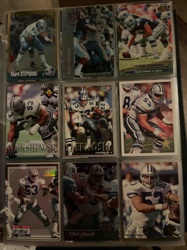
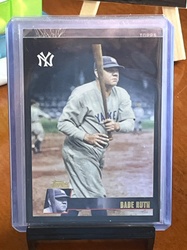
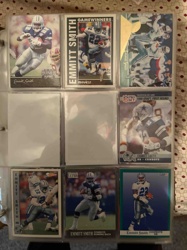
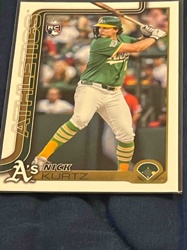
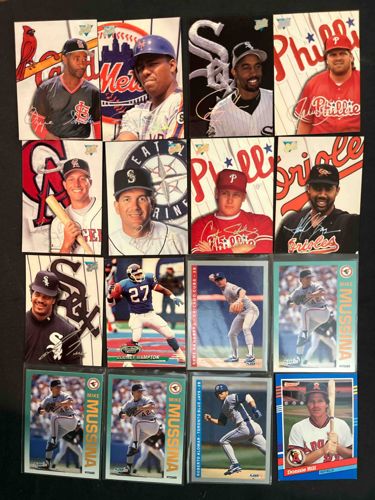
This is a mixed lot of 16 professional sports trading cards, primarily featuring Major League Baseball players from the early 1990s, with a single NFL football card. The collection is dominated by 1992 Fleer Baseball cards, recognizable by their distinct design featuring large, stylized team logos (like the White Sox 'SOX' or 'Phillies' script) acting as a backdrop to the player portrait. Featured athletes include early-career stars such as Mike Mussina (multiple 1992 Fleer Ultra rookies/early years) and Roberto Alomar. The single football card depicts Rodney Hampton (#27) of the New York Giants. Physically, the cards are standard 2.5 by 3.5 inches, printed on gloss-coated cardstock. Several cards in the bottom rows are protected by individual clear plastic soft sleeves (penny sleeves), indicating a higher level of care for those specific items. The upper cards appear to be loose. The condition varies; while some show relatively sharp corners and vibrant colors, others may have minor edge wear or surface scratches consistent with age and stacking. These cards represent the 'Junk Wax' era of the late 80s/early 90s, where mass production was at its peak. Notable markings include the 'Fleer' and 'Ultra' logos, along with printed facsimile signatures on the standard 1992 Fleer base designs. The craftsmanship is typical of high-volume commercial printing from the era, featuring full-bleed photography and bold graphic typography.
AI Appraisal Report

·AI can make mistakes·Verify before acting
I have examined the provided description and image data for this 16-card collection of primarily early 1990s baseball cards. The lot is headlined by 1992 Fleer and Fleer Ultra Mike Mussina cards, alongside a Rodney Hampton football card. Based on visual inspection, the cards present in decent 'raw' condition; however, the 'Junk Wax' era (1987–1994) was defined by extreme overproduction. Even Hall of Fame subjects like Alomar and Mussina from these specific sets were printed in such high volume that they remain extremely common in the secondary market. While the presence of protective penny sleeves on several cards suggests a level of care, the market value for these specific issues is negligible unless they are professionally graded as Gem Mint (PSA 10), which these do not appear to be upon close visual inspection of edge wear and centering. Currently, these cards sell individually for pennies, and as a small bulk lot, they function primarily as nostalgia pieces rather than investment-grade assets. Verification via digital image has significant limitations. A physical inspection would be required to detect surface micro-scratching, corner softening, or signs of 'bricking' common in gloss-coated Fleer Ultra stock. To provide a definitive valuation, I would need to inspect the cards under 10x magnification to evaluate the integrity of the registration and ink patterns. Given the low market value of these specific years, formal provenance documentation is typically not sought, as the cost of authentication would far exceed the market value of the collection itself.

Get your items appraised

Instant estimates of your treasures with AI-powered appraisals

Browse More Appraisals