AI estimate as of October 14, 2026 · verify with a professional before acting
AI-Generated · Verify before acting
Everything on this page is generated by AI for informational purposes only. AI can make mistakes — the AI may misidentify items or misattribute them (artist, maker, brand, designer, origin, era). This is not an official valuation and should not be used for insurance, sale, tax, estate, legal, or lending purposes — or any decision requiring a certified appraisal. It is not an authoritative claim about any person, brand, or rights holder — do not share or rely on it as a factual statement about a third party. Always consult qualified professionals before making financial decisions.
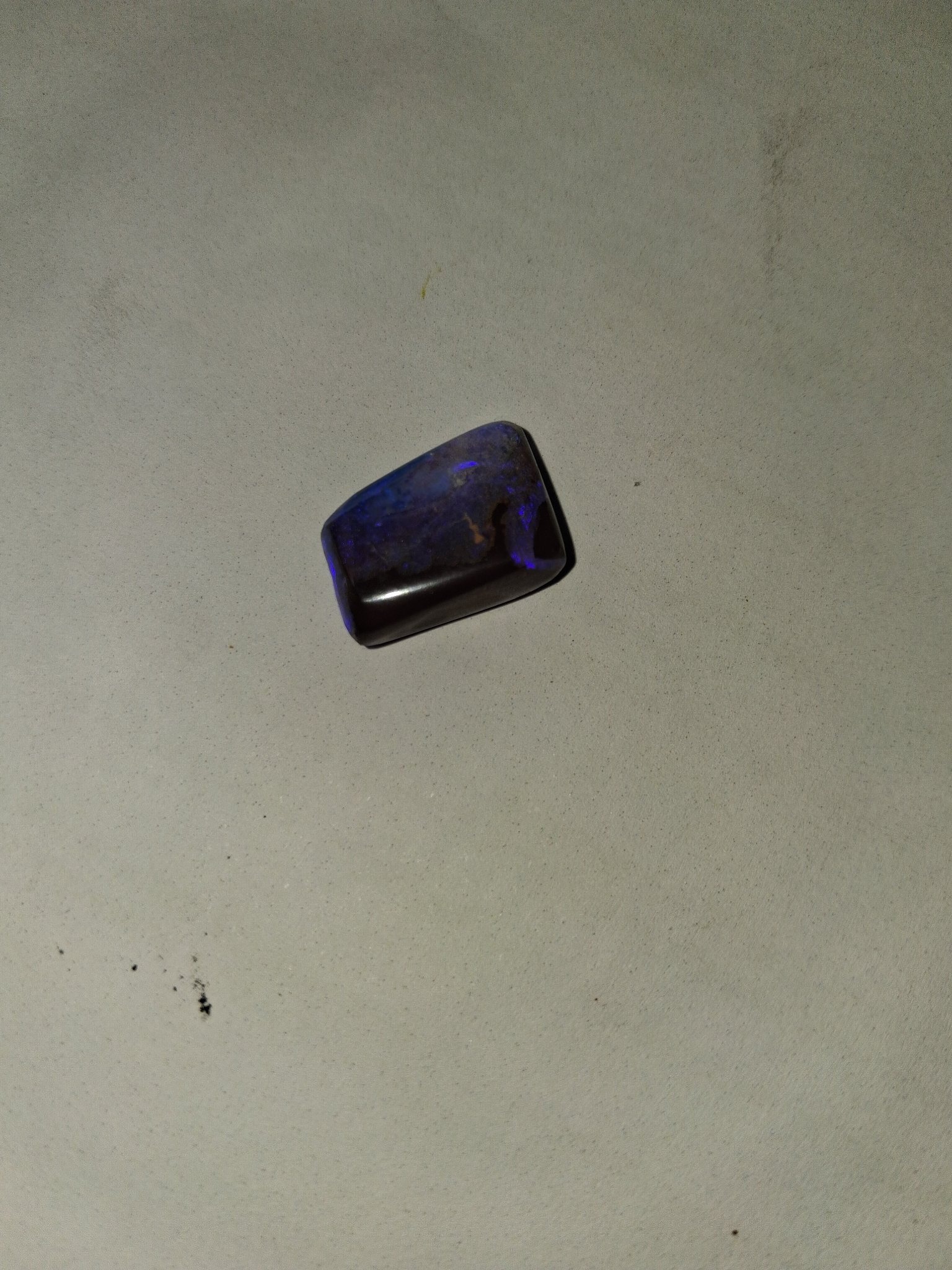
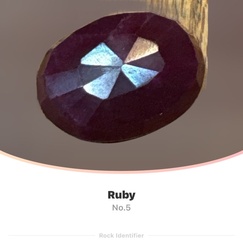
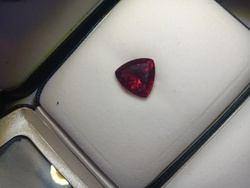
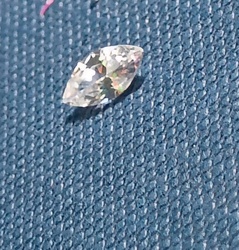
The item is a polished, freeform cabochon-cut gemstone resting on a textured light grey or off-white surface. The physical characteristics display a dark, near-black body tone with vibrant flashes of electric blue and violet play-of-color concentrated near the upper and left edges. The stone has a smooth, curved upper surface with a high-gloss polish that reflects light, suggesting careful lapidary work. There are no visible maker's marks, stamps, or signatures, as is typical for loose gemstones. The identification rests purely on visual characteristics such as the dark matrix and characteristic spectral play-of-color, which are consistent with an Australian black opal, though the piece is unauthenticated and its exact origin, treatment status, and natural versus synthetic status cannot be determined from a photograph alone. The condition appears to be well-polished with no glaring chips or surface fractures visible at this resolution, though microscopic examination would be required to verify surface integrity.
AI Appraisal Report
Based on what I can see in the photograph, this polished, freeform cabochon-cut gemstone exhibits a dark, near-black body tone with vibrant flashes of electric blue and violet play-of-color, characteristics visually consistent with an Australian black opal. The stone features a smooth, curved upper surface with a high-gloss finish. However, I cannot verify from a photo alone whether the piece is natural, treated, or synthetic, as visual characteristics alone are insufficient to rule out laboratory creation or enhancement treatments. Furthermore, I would need physical inspection and gemological testing to confirm its identity. If the assumed identification as a natural Australian black opal is correct, a loose gemstone of this visual quality and color play typically commands a market value in the $1,200 to $2,500 range, driven by strong demand for high-contrast play-of-color in dark body tone opals. Condition is a critical factor; while the surface appears well-polished with no glaring chips visible at this resolution, microscopic examination would be required to verify surface integrity and check for internal crazing or stabilization treatments. If the stone were to turn out to be a synthetic counterpart, doublet, triplet, or a lower-grade imitation, the market value would drop significantly, likely ranging from $50 to $200. To establish a finalized value and confirm authenticity, physical gemological evaluation utilizing magnification, spectroscopy, and specific gravity testing by a qualified specialist is necessary.