AI estimate as of December 10, 2025 · verify with a professional before acting
AI-Generated · Verify before acting
Everything on this page is generated by AI for informational purposes only. AI can make mistakes — the AI may misidentify items or misattribute them (artist, maker, brand, designer, origin, era). This is not an official valuation and should not be used for insurance, sale, tax, estate, legal, or lending purposes — or any decision requiring a certified appraisal. It is not an authoritative claim about any person, brand, or rights holder — do not share or rely on it as a factual statement about a third party. Always consult qualified professionals before making financial decisions.
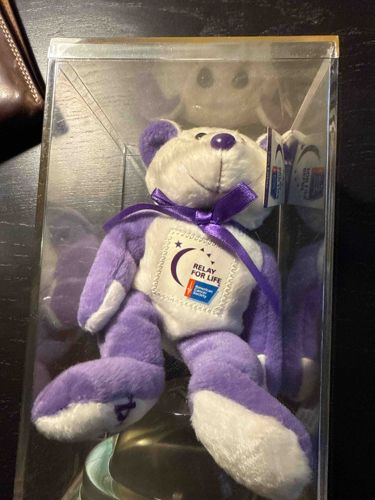
This item is a plush teddy bear designed for the American Cancer Society's 'Relay For Life' event. The bear is predominantly purple and white, featuring a soft, short-pile plush material. Its main body and legs are a vibrant purple, while its muzzle, inner ears, and footpads are white. The bear has classic teddy bear styling, with small, rounded ears, a pronounced snout, and a sitting posture. The eyes are small, dark, and bead-like, and the nose is a shiny, purple, spherical button. A delicate purple satin ribbon is tied in a bow around its neck. A notable feature is a white fabric patch stitched onto its chest, resembling a postage stamp with a scalloped edge. This patch prominently displays the 'Relay For Life' logo, which includes a crescent moon design and the text 'American Cancer Society' with its recognizable flag-like symbol. On the sole of its left foot, there is a small, embroidered purple symbol, possibly representing the 'Relay For Life' logo or a related emblem. The bear appears to be in excellent, likely new, condition, housed within a clear, rectangular plastic case, suggesting it has been preserved as a collectible or commemorative item. There are no visible signs of wear, damage, repairs, or fading, indicating it has been well-protected. The manufacturing details, such as a maker's mark or specific year, are not fully discernible from the image, aside from the prominent American Cancer Society branding on the chest patch and a tag visible on the bear's right side, likely containing additional product information. The clear plastic case has a gold-colored trim around its top edge. The overall craftsmanship appears to be standard for mass-produced plush toys, with good stitching and material consistency. Its style points to a contemporary commemorative item, likely from the 21st century.
AI Appraisal Report
Based on my visual examination of the provided image, this Relay For Life Commemorative Plush Bear appears to be in excellent, likely new, condition. The clear plastic case suggests it has been preserved as a collectible. Authenticity is strongly supported by the prominent 'Relay For Life' and 'American Cancer Society' branding on the chest patch and the embroidered symbol on the foot. The overall craftsmanship is consistent with mass-produced commemorative plush toys.
My assessment of market conditions for similar charitable event-related plush bears indicates a relatively modest demand. While these items hold sentimental value for participants and supporters, they generally do not command high prices in the secondary market. Comparables for other commemorative charity bears typically fall in the $15-$50 range, especially if not associated with a major brand collaboration or limited edition run. This bear's rarity is low; such items are usually produced in significant quantities to support fundraising efforts.
The primary factors impacting value are its condition and association with a well-known charity, which provides inherent appeal to a niche collector base. However, the lack of significant age, unique design elements, or high-profile artist collaboration keeps its monetary value modest.
It is important to note the limitations of authenticating solely from images. While the branding appears legitimate, a full authentication would require in-person examination to verify the material quality, stitching integrity, and inspect any hidden tags or markings. Provenance documentation, such as original purchase receipts or certificates, would definitively confirm its origin. Scientific testing is not typically applicable for this type of item to confirm authenticity but could hypothetically be used to date materials if specific dyes or fibers were in question.