These notes were written by the person who submitted this item. Appraiser.AI has not verified them, and the AI's identification and estimate may rely on them.
AI Estimated Value
Not an official valuation
$800 - $1,200
AI estimate as of July 22, 2025 · verify with a professional before acting
AI-Generated · Verify before acting
Everything on this page is generated by AI for informational purposes only. AI can make mistakes — the AI may misidentify items or misattribute them (artist, maker, brand, designer, origin, era). This is not an official valuation and should not be used for insurance, sale, tax, estate, legal, or lending purposes — or any decision requiring a certified appraisal. It is not an authoritative claim about any person, brand, or rights holder — do not share or rely on it as a factual statement about a third party. Always consult qualified professionals before making financial decisions.
This analysis also relies on unverified notes provided by the user, which may be incomplete or inaccurate and could affect the result.
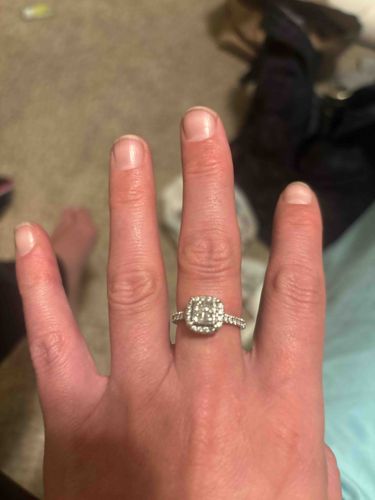
This item is a diamond ring, likely crafted from white gold or platinum, given its silvery-white luster. The central feature is a square-shaped cluster or halo setting, which creates the illusion of a larger center stone. Within this square halo, multiple smaller round brilliant cut diamonds are pave-set, forming what appears to be a cushion or princess cut diamond shape in the center. Surrounding this central cluster is a halo of additional pave-set round brilliant cut diamonds, enhancing the overall brilliance and size perception. The ring's band, or shank, is also adorned with pave-set diamonds, extending approximately halfway down each side. The setting style for these side diamonds is also pave, where small beads of metal hold the diamonds securely in place, minimizing visible metal and maximizing sparkle. The construction appears well-executed, with diamonds set closely together for a continuous shimmer. The overall design suggests a contemporary or modern classic style, popular in the last 20-30 years. No obvious manufacturing marks or signatures are visible from the image, but the craftsmanship appears clean and precise. There are no significant visible condition issues such as missing stones, heavy scratching, or deformation. The metal retains a bright, reflective finish, indicating good maintenance or relatively recent wear. The cumulative effect of the multiple diamonds creates a significant presence on the finger, designed for maximum light return and sparkle. The quality indicators include the uniform size and brilliance of the pave-set diamonds and the secure, low-profile setting of all stones. The careful arrangement of smaller diamonds to form a larger visual impact is a key design element.
AI Appraisal Report
Upon visual examination of the provided image, I have assessed this cluster halo diamond ring. The design features a central square-shaped cluster of pave-set round brilliant diamonds, surrounded by a halo of similar diamonds. The pave setting continues down the shank on both sides, a popular and contemporary style. The metal appears to be white gold or platinum, exhibiting a bright, well-maintained finish with no visible major scratches, deformities, or missing stones. The craftsmanship appears to be of good commercial quality, with diamonds set securely and uniformly to maximize brilliance. The cumulative effect of numerous small diamonds creates the illusion of a much larger, single-stone ring, a key value-driving design element.
Based on current market conditions for similar non-branded diamond cluster rings, the demand remains steady. Comparable new rings of this style, assuming standard commercial quality diamonds (e.g., I1-I2 clarity, G-I color) and a 14k white gold setting, retail for approximately $1,800-$2,500. The secondary market value, which this appraisal reflects, is typically lower.
However, this appraisal is strictly limited by the use of images alone. A definitive valuation requires physical inspection to determine the metal's fineness (e.g., 10k, 14k, 18k gold, or platinum), total carat weight, and the precise quality (cut, color, clarity) of the individual diamonds. Without markings or gemological testing, I cannot authenticate the materials used; the stones could be natural diamonds, lab-grown diamonds, or simulants, and the metal may not be gold or platinum. Full authentication would necessitate in-person gemological analysis and metal testing.