AI estimate as of October 9, 2025 · verify with a professional before acting
AI-Generated · Verify before acting
Everything on this page is generated by AI for informational purposes only. AI can make mistakes — the AI may misidentify items or misattribute them (artist, maker, brand, designer, origin, era). This is not an official valuation and should not be used for insurance, sale, tax, estate, legal, or lending purposes — or any decision requiring a certified appraisal. It is not an authoritative claim about any person, brand, or rights holder — do not share or rely on it as a factual statement about a third party. Always consult qualified professionals before making financial decisions.
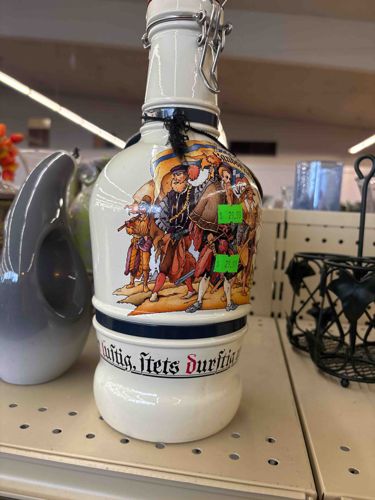
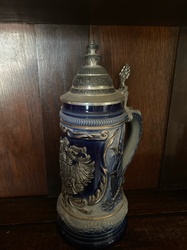
This item is a ceramic flagon or bottle, likely designed for holding beer or other beverages, characterized by its traditional German styling. It features a predominantly white glazed ceramic body with a distinctive swing-top closure mechanism made of metal, likely pewter or a similar alloy, which secure a ceramic stopper. The overall form is bottle-shaped, with a wider, rounded base tapering upwards to a narrower neck. The main body of the flagon is decorated with a colorful, detailed illustration depicting a group of historical figures, possibly musicians or revelers in traditional attire, rendered in hues of red, orange, brown, and blue against an earthy background. This artwork wraps around a significant portion of the mid-section. Below this central image, there is a band of dark blue, followed by text printed in a Gothic-style font which appears to read 'lustig, stets durstig' (German for 'merry, always thirsty'), with 'durstig' highlighted in red. The craftsmanship appears to be robust, typical of stoneware or earthenware vessels. There are no immediately obvious signs of chips, cracks, or significant damage from the visible areas, though a black string or cord is tied around the neck, which might be decorative or functional (e.g., for carrying). The item has two green pricing stickers affixed to the illustrated portion, indicating it was likely purchased from a retail or thrift store. The style suggests it could be a commemorative piece or a souvenir, possibly dating from the mid to late 20th century. The sturdy construction and classic design are hallmarks of traditional German beer steins and flagons, indicating a degree of quality suitable for practical use or decorative display.
AI Appraisal Report
Having carefully examined the provided images of this German-style ceramic flip-top beer bottle, I can offer an appraisal based on its visible attributes. The flagon appears to be in good overall condition, with no immediate visual evidence of chips, cracks, or significant damage to the ceramic body or the metal swing-top mechanism. The glazes retain their color and luster. The decoration, depicting historical figures and the German phrase 'lustig, stets durstig,' is well-preserved and contributes to its traditional German aesthetic. The swing-top closure, a common feature on such vessels, appears intact. The presence of two retail stickers suggests it's likely a relatively modern (mid to late 20th century) souvenir or decorative piece, rather than an antique, which is further implied by the general style and mass-produced feel of the illustration.
Market conditions for such flagons are generally stable but not highly lucrative. Comparables in similar condition, often found in antique malls, thrift stores, or online marketplaces, typically range from $20 to $60. Demand is moderate, primarily from collectors of German memorabilia, beer stein enthusiasts, or those seeking decorative accent pieces. The item is not considered rare; many similar examples were produced over decades. Factors impacting value include the lack of a prominent maker's mark (none visible), the mass-produced nature of the decoration, and its apparent age. Without physical inspection, I cannot verify the material composition beyond general ceramic, confirm the integrity of the swing-top seal, or check for hairline cracks or repairs not visible in the images. An in-person examination would be necessary to check for manufacturer's marks on the base, assess the metal closure's specific composition (e.g., pewter vs. base metal), and verify any hidden damage or repairs, which would allow for full authentication of its age and origin.