AI estimate as of October 10, 2025 · verify with a professional before acting
AI-Generated · Verify before acting
Everything on this page is generated by AI for informational purposes only. AI can make mistakes — the AI may misidentify items or misattribute them (artist, maker, brand, designer, origin, era). This is not an official valuation and should not be used for insurance, sale, tax, estate, legal, or lending purposes — or any decision requiring a certified appraisal. It is not an authoritative claim about any person, brand, or rights holder — do not share or rely on it as a factual statement about a third party. Always consult qualified professionals before making financial decisions.
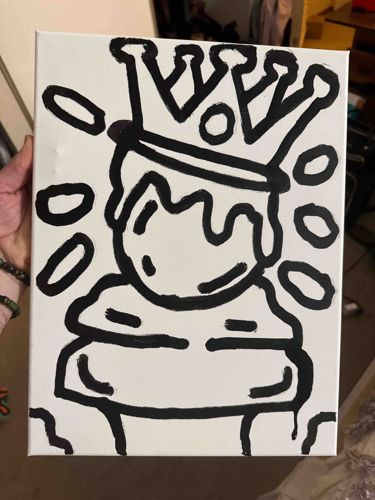
This item is a contemporary abstract painting executed on a stretched white canvas. The artwork features a stylized, amorphous figure with a crown, rendered solely in thick, bold black lines against a stark white background. The figure's head appears to be 'melting' or dripping, indicated by undulating lines descending from the crown. The crown itself is composed of several large, jagged points, giving it a somewhat organic or crudely drawn appearance. Around the central figure, there are several irregular, oval-shaped black outlines, possibly representing abstract elements or decorative motifs, which are not uniformly spaced or sized, contributing to the hand-drawn aesthetic. The overall style is reminiscent of street art or primitive art, characterized by its simplicity and directness. The paint appears to be acrylic or oil, applied somewhat thickly, showing brushstrokes or applicator marks within the black lines, giving them texture. The canvas itself is rectangular, with an approximate visible size that suggests a standard small to medium-format art piece. There are no visible artist's signatures or marks on the front of the canvas. The canvas edges appear neat and wrapped. The condition appears good, with no obvious tears, significant blemishes, or damage to the canvas or paint layer, though some minor ripples or inconsistencies in the canvas surface are visible, particularly in the top left quadrant. The back of the canvas is not visible, so details on stretcher bars or hanging hardware cannot be assessed. This piece reflects a modern, perhaps youthful, artistic expression, focused on shape and contrast over detailed representation.
AI Appraisal Report
I have thoroughly examined the provided image of the Abstract Crowned Figure Painting on Canvas. The condition of the artwork appears good, with no obvious signs of significant damage like tears or major abrasions. I do observe minor ripples or inconsistencies in the canvas surface, particularly in the top left, which is common in stretched canvases of this type and does not significantly detract from its value. Authenticity, based solely on visual examination of an image, is limited; without a visible signature or artist's mark, attribution is impossible. An in-person inspection would be crucial to verify the paint medium, assess texture, and inspect the canvas's reverse for any hidden markings, stretcher bar condition, or labels.
Market conditions for contemporary abstract art by unestablished artists are variable. This piece's street art/primitive aesthetic offers a distinct visual appeal. Comparable pieces by emerging or unknown artists in this style typically sell in the lower to mid-range. Demand for such pieces is often driven by individual aesthetic preferences rather than established market trends or artist recognition. The absence of provenance documentation significantly impacts value, as does the lack of an identifiable artist, placing it firmly in the decorative art category.
Factors impacting value include its unique, albeit unsigned, design and good apparent condition. However, the lack of an artist's signature, provenance, and the inability to definitively confirm the medium or an artist's reputation without physical inspection or documentation limits its value to the decorative art market. Full authentication would require in-person examination, any available provenance documentation, and potentially scientific testing of the paint if an artist were to be suggested. My valuation reflects its decorative merit rather than its investment potential as a recognized artwork.