AI estimate as of October 12, 2025 · verify with a professional before acting
AI-Generated · Verify before acting
Everything on this page is generated by AI for informational purposes only. AI can make mistakes — the AI may misidentify items or misattribute them (artist, maker, brand, designer, origin, era). This is not an official valuation and should not be used for insurance, sale, tax, estate, legal, or lending purposes — or any decision requiring a certified appraisal. It is not an authoritative claim about any person, brand, or rights holder — do not share or rely on it as a factual statement about a third party. Always consult qualified professionals before making financial decisions.
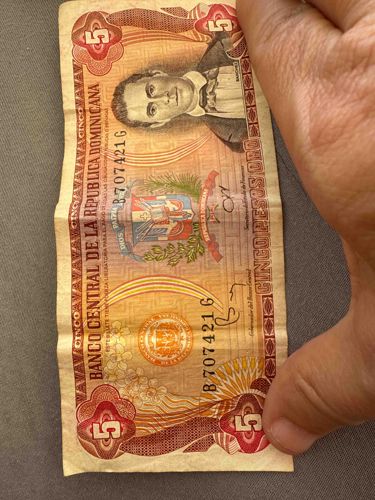
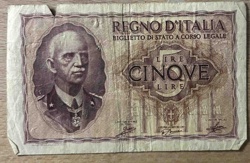
This item is a 5 Pesos Oro banknote from the Dominican Republic, featuring a portrait of a prominent historical figure on the obverse. The banknote is predominantly reddish-brown and orange in color, printed on paper. Physical characteristics include a rectangular shape, typical of currency notes, with visible creasing and folds, particularly a prominent vertical fold down the center and several horizontal creases, indicating significant circulation and handling. The edges appear somewhat softened and worn, but no major tears are immediately apparent, though the corners may exhibit some minor dog-earing.
Notable features include the denomination '5' prominently displayed in all four corners, with 'CINCO' (Spanish for five) also present both vertically along the left border and horizontally near the right. The central image is a portrait of a stoic-looking man in formal attire, likely a national hero, with 'BANCO CENTRAL DE LA REPÚBLICA DOMINICANA' printed along the left side. Beneath the portrait, the national coat of arms of the Dominican Republic is visible, featuring a shield with a bible, cross, and flags. A serial number, 'B 7074216 G', is printed twice on the obverse side: once diagonally across the center and once horizontally in the lower right quadrant. The phrase 'CINCO PESOS ORO' appears on the right edge.
Manufacturing details are implied by 'BANCO CENTRAL', indicating it was issued by the central bank. The design aesthetic suggests a mid-20th century style, possibly from the 1960s or 1970s, common for banknotes of that period with detailed portraiture and national symbols. The general condition points to a circulated banknote, not uncirculated, reflecting its use as legal tender. The quality of printing is characteristic of sovereign currency, designed for security and widespread use, though specific craftsmanship details beyond typical lithography are not discernible from the image. The overall appearance suggests authenticity as a genuine banknote.
AI Appraisal Report
Upon examining the provided image, I have assessed this item to be a Dominican Republic 5 Pesos Oro banknote, likely a P-118 issue from the 1980s. The banknote features the national hero, Francisco del Rosario Sánchez. My assessment is based on the visible features, including the portrait, the national coat of arms, the serial number B 7074216 G, and the overall design characteristic of this era.
The banknote's condition is heavily circulated. I noted significant creasing, including a prominent central vertical fold and multiple horizontal folds. The paper appears softened with worn edges and corners, consistent with extensive public use. These condition issues are the primary factor limiting its value; collector demand is strongest for notes in uncirculated (UNC) or near-uncirculated condition.
Market analysis reveals that these particular notes were printed in large quantities and are common in the numismatic market, especially in circulated grades. Comparable sales for similar heavily circulated examples typically fall in the low single-dollar range. The value lies more in its historical context than in its rarity or condition.
While the banknote appears authentic based on the printing style and design elements, I must stress the limitations of a digital image-based appraisal. A full, definitive authentication would require in-person examination to feel the paper texture, inspect for watermarks, and check for security threads or other covert features under magnification and specialized lighting. Without physical inspection, I cannot completely rule out the possibility of a high-quality counterfeit.