AI estimate as of September 19, 2025 · verify with a professional before acting
AI-Generated · Verify before acting
Everything on this page is generated by AI for informational purposes only. AI can make mistakes — the AI may misidentify items or misattribute them (artist, maker, brand, designer, origin, era). This is not an official valuation and should not be used for insurance, sale, tax, estate, legal, or lending purposes — or any decision requiring a certified appraisal. It is not an authoritative claim about any person, brand, or rights holder — do not share or rely on it as a factual statement about a third party. Always consult qualified professionals before making financial decisions.
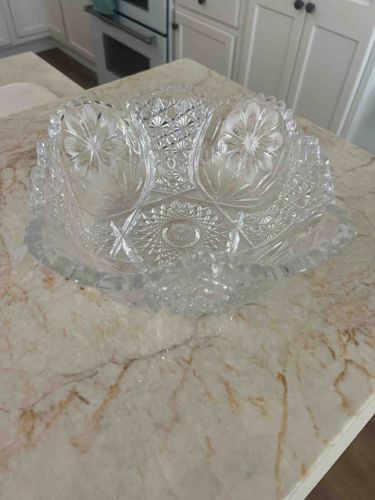
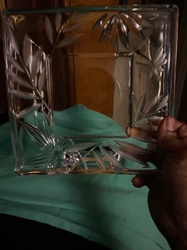
This is a fine example of an American Brilliant Period cut glass bowl, likely dating from the late 19th to early 20th century (approximately 1880-1920). The bowl is crafted from clear, highly refractive lead crystal, exhibiting exceptional brilliance and sparkle due to its deep and intricate cuttings. Its form is shallow and broad, typical of serving bowls from the era, with an undulating rim that adds to its ornate appearance. The pattern is complex, featuring a combination of hobstar variants, cross-hatching (referred to as 'diamond cutting' or 'strawberry diamond'), fan cuts, and possibly vesicas. Specifically, there are prominent six-point hobstars alternating with areas of fine cross-hatching around the outer circumference. The base appears to have a central hobstar or a similar radiating starburst motif, encircled by additional geometric patterns. The craftsmanship is evident in the sharpness and precision of the cuts, which are consistently deep and clear, indicating high-quality hand-cutting. There are no immediately visible chips, cracks, or repairs from the provided image, suggesting good overall condition. Minor wear consistent with age, such as faint scratches or occasional fleabites along the edges of the cuts, would be expected but are not discernible. The heavy lead crystal construction provides a substantial feel, characteristic of the period's best work. The intricate patterns catch and refract light beautifully, a hallmark of American Brilliant cut glass, designed to maximize optical effect.
AI Appraisal Report
This American Brilliant Period cut glass bowl is a commendable example of early 20th-century craftsmanship. From my visual examination, the clarity of the lead crystal and the intricate, deep cuttings—featuring hobstar variants, precise cross-hatching, and fan cuts—point to high-quality production during the 1880-1920 era. The undulating rim and substantial construction are also characteristic of the period's finer pieces. The overall condition appears to be very good; I observe no obvious chips, cracks, or repairs from the image provided. This level of preservation significantly enhances its marketability.
Market conditions for American Brilliant Cut Glass have seen some fluctuations, but well-preserved, complex patterns like this continue to attract collectors. Comparable pieces of this size and pattern complexity, especially those free of significant damage, typically fetch prices in the mid-hundreds. The detailed pattern, particularly the alternating prominent hobstars and fine cross-hatching, contributes to its aesthetic appeal and demand. While not exceedingly rare, its excellent condition and intricate design make it a desirable item.
Factors significantly impacting value include the precision and depth of the cuts, the brilliance of the crystal, and the absence of damage. The fine hand-cutting here is a strong positive. However, it is crucial to note the limitations of photographic examination. While the image suggests excellent condition, an in-person physical inspection is essential to confirm the absence of minute fleabites along the edges of cuts, internal bruising, or faint scratches that would impact value. Furthermore, while the style is authentic, definitive maker identification is generally not possible without physical inspection for acid stamps or signatures, or provenance documentation. Without a signature, it's typically attributed to the period rather than a specific factory. Scientific testing for lead content is not usually performed for such items but would confirm lead crystal composition.