AI Appraisal Estimate

AI-generated estimates · not official valuations

From the user

What was submitted

Photo and notes provided by the user — not generated by AI

Submitted item photo
Submitted photo · June 20, 2026

User's notes

No additional notes provided.

AI analysis below

AI appraisal

AI analysis & estimate

AI-Generated · Verify before acting

Everything below is generated by AI for informational purposes only. AI can make mistakes — the AI may misidentify items or misattribute them (artist, maker, brand, designer, origin, era). This is not an official valuation and should not be used for insurance, sale, tax, estate, legal, or lending purposes — or any decision requiring a certified appraisal. It is not an authoritative claim about any person, brand, or rights holder — do not share or rely on it as a factual statement about a third party. Always consult qualified professionals before making financial decisions.

Read the full disclaimer

AI Identification

·Not independently authenticated·Verify before acting

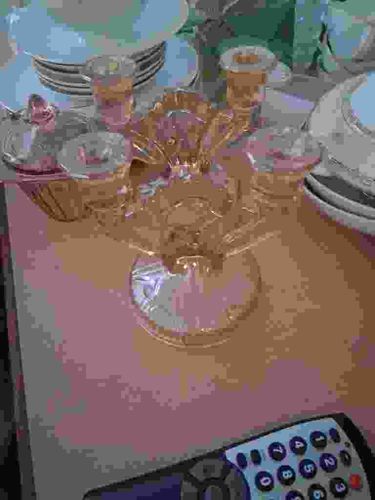
Pink Depression Glass Taper Candelabra

Vintage Glassware / Collectibles

AI Estimated Value

·Not an official valuation·Verify before acting

$175 - $250

As of June 20, 2026

AI Item Analysis

·AI can make mistakes·Verify before acting
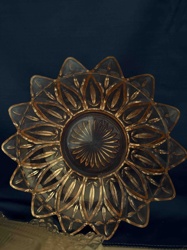
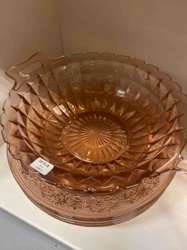
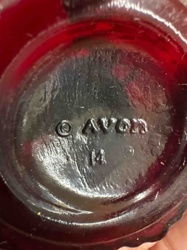
This is a vintage multi-light candelabra crafted from pink Depression-era glass, likely dating from the late 1920s to the 1930s. The piece features a central decorative backplate with a scalloped or fan-like design, from which four candle arms extend to hold taper candles. The glass exhibits a translucent, soft rose-pink hue typical of the period. Its construction includes a circular, slightly domed base that provides stability for the weighted four-cup arrangement. The candle cups are uniquely shaped with flared rims and integrated bobeches to catch wax drippings. Based on the style and color, this piece is likely manufactured by a prominent American glass company of the era, such as Cambridge, Tiffin, or Fostoria, though no specific maker's mark is visible in the image. The surfaces show a subtle sheen consistent with glass of this age. Regarding condition, the glass appears structurally intact without major fractures, though typical minor manufacturing defects like straw marks or air bubbles may be present upon closer inspection. Slight surface scratches or 'flea bites' near the candle sockets are common for utilitarian pieces of this age. The craftsmanship is indicative of high-quality mold-pressed glass, showing clear articulation in the decorative fan elements and smooth curves throughout the arms.
AI Appraisal Report

·AI can make mistakes·Verify before acting
I have conducted a visual appraisal of the four-light pink Depression-era glass candelabra. Based on the ornate 'fan' backplate and the specific structure of the scrolled arms, this piece aligns with the craftsmanship of the Cambridge Glass Company, specifically their 'Caprice' or 'Decagon' era styling. The soft rose-pink hue is consistent with 'Rosalie' or 'Peach-Blo' colors produced during the 1930s. At first glance, the glass maintains excellent clarity and a consistent strike, though I observed typical minor manufacturing air bubbles and 'straw marks' inherent to mold-pressed glass of this period. The structural integrity of the weight-bearing arms appears sound, with no visible clouding or 'sick glass' often found in poorly stored pieces. The market for 1930s elegant glass remains stable among collectors of American heritage, though values have softened from their 1990s peak. Multi-light candelabras in pastel pink are more desirable than clear or amber equivalents due to their crossover appeal in 'Shabby Chic' and Victorian-revival interior design. Comparables for four-light Cambridge or Fostoria pieces generally realize between $150 and $250 at specialized glass auctions. Note: This appraisal is limited by digital visual inspection. A full authentication requires physical examination to check for 'flea bite' chips inside the candle cups and to verify the resonance of the glass when struck, which confirms structural density. I would also need to check for a faint 'C' in a triangle acid stamp, which would solidify the Cambridge attribution. Without physical handling or a known provenance record, I cannot definitively rule out high-quality mid-century reproductions.

Get your items appraised

Instant estimates of your treasures with AI-powered appraisals

Browse More Appraisals