AI estimate as of July 12, 2025 · verify with a professional before acting
AI-Generated · Verify before acting
Everything on this page is generated by AI for informational purposes only. AI can make mistakes — the AI may misidentify items or misattribute them (artist, maker, brand, designer, origin, era). This is not an official valuation and should not be used for insurance, sale, tax, estate, legal, or lending purposes — or any decision requiring a certified appraisal. It is not an authoritative claim about any person, brand, or rights holder — do not share or rely on it as a factual statement about a third party. Always consult qualified professionals before making financial decisions.
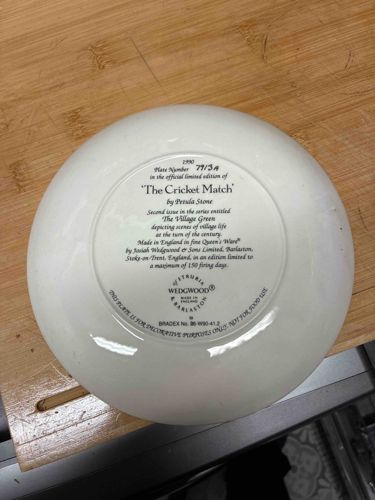
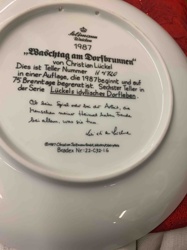
This item is a decorative collector's plate, white in color, made of fine Queen's Ware by Wedgwood. The reverse side of the plate, which is visible in the image, is predominantly white with a slightly glossy finish, indicating it is likely glazed ceramic. The plate's construction appears to be high quality, with no visible chips, cracks, or significant wear on the reverse, suggesting good preservation or limited handling. The design on the back is printed in black text, providing comprehensive manufacturing and edition details. It is clearly legible and centrally placed. The text includes the year '1990', the plate number '79/34' within an official limited edition. The specific artwork depicted on the front (which is not visible) is titled 'The Cricket Match' by Perula Stone, identified as the 'Second issue in the series entitled The Village Green' which depicts 'scenes of village life at the turn of the century'. The manufacturing details confirm it was 'Made in England' by 'Josiah Wedgwood & Sons Limited, Barlaston, Stoke-on-Trent, England'. A notable aspect is the limited edition run, specified as 'a maximum of 150 firing days', implying a strict production cap, which suggests rarity. The Wedgwood logo is prominent, and the manufacturing location 'MADE IN ENGLAND BARLASTON' is also present. Additionally, it features a 'BRADEX No.: 26-W90-41.2', which is a collector's plate identification number, typically used for tracking and cataloging. Around the edge of the central text, there is a distinct curved inscription that reads 'THIS PROOFED FOR DECORATIVE PURPOSES ONLY. NOT FOR FOOD USE.', clearly indicating its primary function as a decorative collectible rather than dinnerware. The overall condition of the visible side suggests it has been well-maintained. The absence of noticeable scratches or fading on the printed details reinforces its preserved state. The craftsmanship appears to be precise, typical of Wedgwood products.
AI Appraisal Report
Upon examining the provided image of the reverse side of 'The Cricket Match' collector's plate by Perula Stone for Wedgwood, I can confirm its apparent excellent condition. The white Queen's Ware ceramic shows no visible chips, cracks, or significant wear, and the printed details are crisp and legible. The authenticity markers—'Josiah Wedgwood & Sons Limited' branding, 'MADE IN ENGLAND BARLASTON' inscription, copyright year 1990, and BRADEX No. 26-W90-41.2—are consistent with genuine Wedgwood collector's plates from this era. The clear indication 'THIS PROOFED FOR DECORATIVE PURPOSES ONLY. NOT FOR FOOD USE.' is standard for such collectibles.
Market conditions for collector's plates, even those from reputable manufacturers like Wedgwood and part of limited editions (stated as 'a maximum of 150 firing days'), have generally seen a decline in value over the past few decades. While this piece is from 'The Village Green' series, which might appeal to niche collectors, overall demand for decorative plates is low. The 'limited edition' status does not equate to high rarity or value in this specific market segment. Comparables for similar Wedgwood collector's plates from the 1990s typically range from $15 to $40. Factors that significantly impact value positively, which are not present here, would be extreme rarity (e.g., prototypes, very small runs), significant historical provenance, or being part of an exceptionally sought-after series (e.g., highly artistic, culturally significant).
My assessment of authenticity is based on visual cues only. For full authentication, I would require in-person examination to assess the tactile quality, precise weight, and minute details not visible in images. Provenance documentation, such as original boxing or certificates of authenticity, would further solidify its history. Scientific testing, like material analysis, is generally not cost-effective or necessary for items in this value range unless significant doubt arises.