AI estimate as of August 14, 2025 · verify with a professional before acting
AI-Generated · Verify before acting
Everything on this page is generated by AI for informational purposes only. AI can make mistakes — the AI may misidentify items or misattribute them (artist, maker, brand, designer, origin, era). This is not an official valuation and should not be used for insurance, sale, tax, estate, legal, or lending purposes — or any decision requiring a certified appraisal. It is not an authoritative claim about any person, brand, or rights holder — do not share or rely on it as a factual statement about a third party. Always consult qualified professionals before making financial decisions.
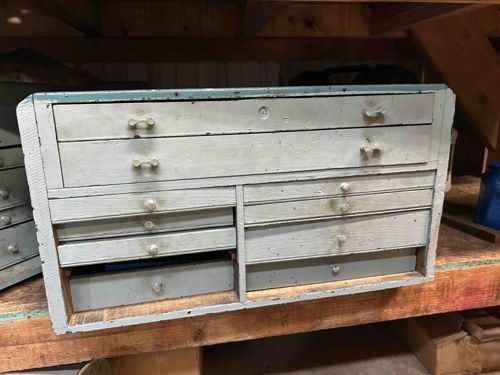
This appears to be a vintage or antique wooden multi-drawer storage cabinet, likely used as a machinist's or craftsman's toolbox. The cabinet is rectangular in shape, constructed from wood, and features a light gray or off-white painted finish with significant signs of wear and age, indicating a distressed or patinated surface. The overall dimensions appear to be consistent with a tabletop or workbench-mounted unit, approximately 2 to 3 feet in width. It features a total of nine drawers, arranged as two full-width drawers at the top, a section of four narrower drawers on the right, and three narrower drawers on the left, with an additional open bay or very shallow drawer at the bottom left. The drawers are equipped with small, off-white or light-colored knob pulls, which appear to be either wooden or ceramic, with visible wear and dirt accumulation. The top-most drawer features a keyhole, suggesting it was once lockable, though the key and functionality are not discernible. The construction seems to be solid wood, possibly pine or a similar soft wood, with visible wood grain and joinery (likely dovetailed or finger-jointed from the visible edges) showing through the worn paint. There are clear indications of heavy use, including chipped paint, scuffs, dirt, and discoloration, particularly on the edges and around the drawer pulls. The bottom edge of the cabinet shows significant wear and possible wood degradation. The overall aesthetic suggests a robust, utilitarian piece from the early to mid-20th century, built for functionality rather than purely decorative purposes. The craftsmanship, while appearing sturdy, lacks the fine finishing of high-end furniture, consistent with industrial or workshop use. No discernible maker's marks or signatures are visible in the provided image.
AI Appraisal Report
I have carefully examined the provided image of what appears to be a vintage wooden multi-drawer workbench cabinet. Based on visual cues, the condition is moderately distressed, showing significant wear, chipped paint, scuffs, and discoloration consistent with heavy workshop use over many decades. The 'distressed' aesthetic, while largely original patina, does impact the condition from a pristine furniture standpoint, though it enhances its utilitarian charm. Authenticity as a genuine vintage piece from the early to mid-20th century appears strong, given the construction style (likely solid wood, possibly pine, with visible joinery), the aged paint finish, and the simple knob pulls typical of functional workshop furniture. The keyhole on the top drawer is a period-appropriate feature for added security.
From a market perspective, there's a steady demand for authentic vintage industrial and workshop furniture, especially pieces that offer functional storage combined with rustic appeal. This cabinet falls into that desirable category. While not extremely rare, multi-drawer units of this size and configuration are not commonplace, particularly in original, unrestored condition. Comparables typically include other vintage machinist chests or apothecary cabinets, often ranging from $200-$600 depending on size, condition, and origin. The lack of discernible maker's marks limits specific historical attribution, which might otherwise increase value. Factors significantly impacting value are its functional utility, distressed aesthetic, and perceived age. The primary limitation in authenticity verification from an image alone is the inability to physically inspect wood species, joinery quality, internal drawer construction, and verify the age of materials (e.g., fasteners, paint layers) through direct examination or scientific testing, such as dendrochronology or paint analysis. I also cannot confirm if the keyhole mechanism is still functional or if the key is present.