AI Appraisal Estimate

AI-generated estimates · not official valuations

From the user

What was submitted

Photo and notes provided by the user — not generated by AI

Submitted item photo
Submitted photo · May 27, 2026

User's notes

No additional notes provided.

AI analysis below

AI appraisal

AI analysis & estimate

AI-Generated · Verify before acting

Everything below is generated by AI for informational purposes only. AI can make mistakes — the AI may misidentify items or misattribute them (artist, maker, brand, designer, origin, era). This is not an official valuation and should not be used for insurance, sale, tax, estate, legal, or lending purposes — or any decision requiring a certified appraisal. It is not an authoritative claim about any person, brand, or rights holder — do not share or rely on it as a factual statement about a third party. Always consult qualified professionals before making financial decisions.

Read the full disclaimer

AI Identification

·Not independently authenticated·Verify before acting

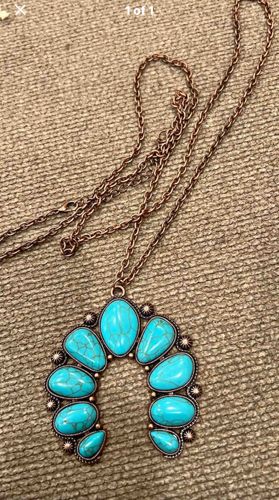
Southwestern Style Faux-Turquoise Squash Blossom Pendant Necklace

Costume Jewelry

AI Estimated Value

·Not an official valuation·Verify before acting

$25.00 - $45.00

As of May 27, 2026

AI Item Analysis

·AI can make mistakes·Verify before acting
This piece is a contemporary costume jewelry necklace designed in a Southwestern or Western 'Boho' style. The focal point is a large horseshoe-shaped Naja pendant, which is traditionally the centerpiece of a squash blossom necklace. The pendant features ten synthetic blue turquoise stones, likely made of dyed howlite or plastic, which exhibit a uniform 'matrix' pattern intended to mimic natural stone. These cabochons are set in a copper-toned or antiqued bronze base metal. Small decorative metal beads, known as 'navajo pearls' or silver-style droplets in this aesthetic, are placed between the outer edges of the stones. The pendant is suspended from a long, matching copper-finished cable chain with a lobster claw clasp. Regarding condition, the metal shows a consistent antiqued patina which appears to be a manufactured finish rather than natural oxidation. There are no visible chips to the faux-stones, though the overall craftsmanship suggests mass production rather than artisan-made silversmithing. It lacks maker's marks or hallmarks, typical for 21st-century fashion jewelry. The scale is substantial, intended as a statement accessory.
AI Appraisal Report

·AI can make mistakes·Verify before acting
I have conducted a visual examination of this Southwestern-style Naja pendant necklace. The item is identified as contemporary costume jewelry, designed to replicate the aesthetic of traditional Navajo silversmithing using non-precious materials. The central Naja consists of a base metal with an 'antique copper' plating and features ten simulated turquoise cabochons. The uniform color and repetitive matrix patterns suggest these are molded resin or dyed magnesite/howlite rather than genuine mined turquoise. The chain is a mass-produced cable style consistent with modern retail fashion accessories. The condition appears 'like-new' with a manufactured patina intended to simulate age. Market demand for 'Boho-chic' Western wear remains stable, but the value is capped by the mass-produced nature of the piece and the lack of precious metal content or artisan hallmarks. Similar items are widely available through major retail chains and online marketplaces. Unlike authentic sterling silver and natural gemstone squash blossom jewelry, which can command thousands of dollars, this piece serves as an affordable fashion alternative. Several limitations exist in this image-based appraisal. Without a physical inspection, I cannot perform a 'streak test' or thermal conductivity test on the stones to definitively rule out high-quality polymers versus stone composites. I also cannot verify the base metal composition; while it appears to be a copper-toned alloy, a scratch test or acid test would be required to confirm the absence of silver content. Furthermore, the lack of a maker’s mark limits the ability to trace provenance. A full authentication would require hands-on weighing and a tactile assessment of the stone settings to ensure they are not glued-in plastic.

Get your items appraised

Instant estimates of your treasures with AI-powered appraisals

Browse More Appraisals