AI estimate as of September 2, 2025 · verify with a professional before acting
AI-Generated · Verify before acting
Everything on this page is generated by AI for informational purposes only. AI can make mistakes — the AI may misidentify items or misattribute them (artist, maker, brand, designer, origin, era). This is not an official valuation and should not be used for insurance, sale, tax, estate, legal, or lending purposes — or any decision requiring a certified appraisal. It is not an authoritative claim about any person, brand, or rights holder — do not share or rely on it as a factual statement about a third party. Always consult qualified professionals before making financial decisions.
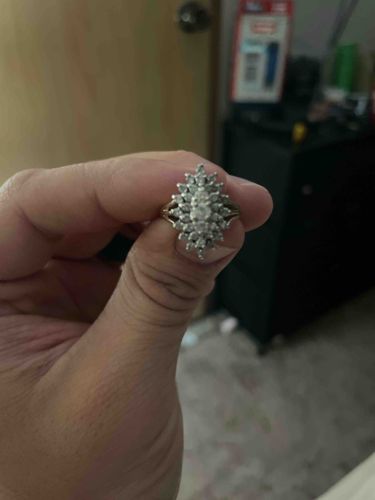
The item is a women's cocktail ring, likely made of gold (suggested by the warmer tone visible on the band) and set with numerous diamonds or diamond simulants. The ring features a pronounced marquise-shaped (or navette-shaped) cluster design, with a central oval or marquise-cut stone surrounded by multiple tiers of smaller round and possibly marquise-cut stones. The overall appearance is quite elaborate and sparkly, indicative of a dress or statement piece. The setting appears to be a prong setting, securing each individual stone within the cluster. From the visible surface, the metal appears to have a polished finish, though some areas may show light wear consistent with regular use. The stones themselves appear clear and well-faceted, contributing to the overall brilliance of the piece, but their exact quality (clarity, color, cut) cannot be definitively assessed from the image. The craftsmanship seems solid for a mass-produced or semi-custom piece, with no immediately apparent major flaws or missing stones. The condition appears to be relatively good, with no obvious signs of damage, repairs, or significant discoloration. Its style suggests a mid-to-late 20th-century aesthetic, possibly 1970s or 1980s, which was a popular period for cluster and marquise-cut diamond jewelry.
AI Appraisal Report
Based on my visual examination of the provided image, this Cluster Diamond Cocktail Ring appears to be in good overall condition. There are no obvious signs of missing stones, significant damage, or extensive wear. The metal tone suggests it is likely gold, possibly 10k or 14k, consistent with jewelry from the probable era. The stones exhibit good general brilliance, indicative of either diamonds or high-quality diamond simulants. The elaborate marquise cluster design aligns with popular styles from the mid-to-late 20th century, specifically the 1970s or 1980s.
Market conditions for this style of vintage cocktail ring are generally stable. Similar gold and diamond cluster rings, even those with smaller or lower-grade diamonds, typically command prices in the low to mid-hundreds, sometimes exceeding a thousand for pieces with higher carat weight or clearer diamonds. Demand exists for vintage statement pieces, though they are not considered exceptionally rare.
Factors significantly impacting value include the metal purity (karatage of gold), the precise carat weight of the stones, and critically, whether the stones are natural diamonds and their quality (cut, color, clarity). If they are simulants, the value would be substantially lower.
It is crucial to note the limitations of authenticating jewelry solely from images. Without in-person examination, I cannot definitively confirm the metal type or purity (e.g., verifying gold content stamps), nor can I ascertain if the stones are genuine diamonds versus high-quality simulants like cubic zirconia or moissanite. Full authentication would require a physical inspection, including the use of a jeweler's loupe to examine diamond characteristics (inclusions, facets), a diamond tester, and potentially a Precious Metal Purity Tester. Provenance documentation, if available, would also greatly assist in verifying its origin and composition.