AI estimate as of October 27, 2025 · verify with a professional before acting
AI-Generated · Verify before acting
Everything on this page is generated by AI for informational purposes only. AI can make mistakes — the AI may misidentify items or misattribute them (artist, maker, brand, designer, origin, era). This is not an official valuation and should not be used for insurance, sale, tax, estate, legal, or lending purposes — or any decision requiring a certified appraisal. It is not an authoritative claim about any person, brand, or rights holder — do not share or rely on it as a factual statement about a third party. Always consult qualified professionals before making financial decisions.
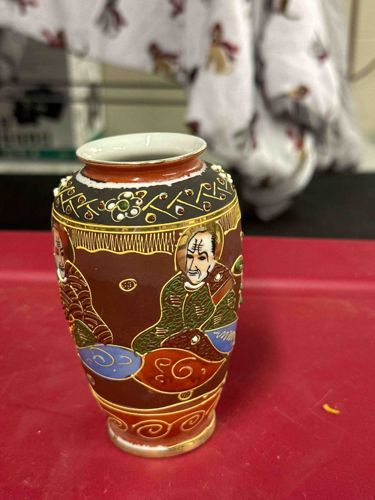
This is a miniature baluster-shaped vase, likely in the Satsuma-style, characterized by its richly decorated surface and intricate enamel work. The vase features a slightly flared rim, a constricted neck, a broad shoulder, and tapers towards a subtly flaring base. The primary color palette includes a deep reddish-brown ground, accentuated with vibrant polychrome enamels and extensive gold detailing. The upper band below the rim displays a pattern of stylized floral motifs and geometric lines with green, white, and red enamels, all outlined in gold. Below this, the main body of the vase depicts figures, suggested to be sages or deities, seated in various postures. One prominent figure is visible with a white or fair complexion, wearing a green garment, with details in blue and red enamels, outlined in gold. Another figure or part of a figure is visible on the left. The base of the vase has an encircling band of intricate gold swirls and red-orange enamel accents. The interior of the rim is a plain white or off-white ceramic, contrasting with the exterior's elaborate decoration. The gold work appears to be meticulously applied, suggesting a good level of craftsmanship. The condition appears to be relatively good with no immediately visible chips or cracks, although some minor wear to the gold gilding or enamel might be present upon closer inspection, which is common for items of this style and potential age. Without a visible maker's mark, it's difficult to ascertain an exact manufacturer or age, but the style points towards a late 19th to early 20th-century Japanese origin, possibly Meiji or Taisho period, or a later reproduction in the same style.
AI Appraisal Report
Upon visual examination of this miniature baluster-shaped vase, its Satsuma-style aesthetics are evident through the rich polychrome enamels and meticulous gold detailing. The condition appears sound with no immediate signs of chips or cracks. The intricate decoration, particularly the figures of sages or deities and the elaborate banding, suggests good craftsmanship for its style. However, authenticating its age and origin precisely without a visible maker's mark is challenging. The style is consistent with late 19th to early 20th-century Japanese production (Meiji/Taisho period), or potentially a later reproduction.
Market conditions for Satsuma-style ware, especially unmarked examples or those not by renowned workshops, have softened in recent years. While decorative, miniature pieces generally command lower prices compared to larger, signed, or historically significant examples. Comparables for smaller, unmarked Satsuma-style vases typically fall into the lower end of the decorative arts market. Demand primarily comes from collectors of Japanese decorative arts and those seeking attractive accent pieces. Rarity is not a significant factor here, as numerous such pieces were produced.
The primary factor impacting value is the lack of a definitive maker's mark and the difficulty in discerning the fineness of the enamel work and gold application solely from images. Without physical inspection, the presence of minor wear, overpainting, or even damage not visible in the provided image cannot be fully assessed. For full authentication and to ascertain its precise age and potential workshop, an in-person examination is crucial, allowing for close inspection of brushstrokes, enamel quality, and ceramic body. Scientific testing of materials or detailed provenance documentation would also significantly aid in verification. Based on visual assessment alone, I would estimate the value to be in the range of $100-250, reflecting its decorative appeal modulated by the uncertainties regarding its precise origin and age.