These notes were written by the person who submitted this item. Appraiser.AI has not verified them, and the AI's identification and estimate may rely on them.
AI Estimated Value
Not an official valuation
$40-70
AI estimate as of July 10, 2025 · verify with a professional before acting
AI-Generated · Verify before acting
Everything on this page is generated by AI for informational purposes only. AI can make mistakes — the AI may misidentify items or misattribute them (artist, maker, brand, designer, origin, era). This is not an official valuation and should not be used for insurance, sale, tax, estate, legal, or lending purposes — or any decision requiring a certified appraisal. It is not an authoritative claim about any person, brand, or rights holder — do not share or rely on it as a factual statement about a third party. Always consult qualified professionals before making financial decisions.
This analysis also relies on unverified notes provided by the user, which may be incomplete or inaccurate and could affect the result.
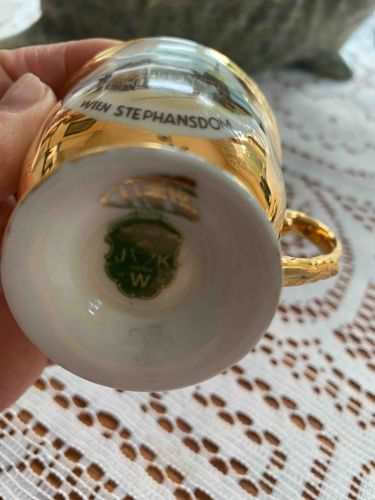
This is a small, ornate porcelain demitasse or espresso cup, characterized by its vibrant aesthetic. The cup is primarily white porcelain, with a lustrous, iridescent quality visible on the interior and bottom of the foot. The exterior, particularly the upper rim and the handle, is heavily gilded with what appears to be a rich, reflective gold finish. The gilding on the handle has a textured, possibly bark-like or gnarled pattern, indicating a decorative rather than purely functional design. A significant feature is the transfer-printed image on the side, depicting an architectural landscape, likely a famous landmark. The text "WIEN STEPHANSDOM" is clearly visible above this image, identifying the subject as St. Stephen's Cathedral in Vienna, thus marking it as a souvenir piece. The base of the cup features a prominent maker's mark within a green, shield-like or gothic-shaped outline. Within this mark, the letters "J K W" are visible, with 'W' situated below 'JK', suggesting the manufacturer JK Wien or a variant thereof, a known producer of fine porcelain. The overall condition appears good, with the gilding largely intact, though there might be minor signs of wear consistent with age and handling. No significant chips, cracks, or repairs are evident from the provided image. The craftsmanship of the gilding and the clarity of the transfer print indicate a quality souvenir item, likely from the early to mid-20th century given the style and typical production of such items.
AI Appraisal Report
Upon examining the provided image of this Vienna St. Stephen's Cathedral porcelain espresso cup, I note its elegant design featuring a white porcelain body with an iridescent interior and foot. The extensive and well-preserved gilding on the rim and handle is particularly striking, with the handle exhibiting a distinctive textured pattern. The transfer-printed image of St. Stephen's Cathedral, clearly identified by "WIEN STEPHANSDOM," firmly establishes its identity as a souvenir piece. The visible "J K W" maker's mark within a green shield on the base strongly suggests attribution to JK Wien, a known fine porcelain manufacturer.
From the image, the cup appears to be in very good condition, with the gilding largely intact and no apparent chips, cracks, or repairs. This speaks to its careful preservation. Such souvenir pieces, especially from reputable manufacturers like JK Wien, typically appeal to collectors of specific regional memorabilia and porcelain. The demand for such items is generally steady, driven by nostalgic or historical interest, though not exceedingly high unless part of a larger, rare set.
Limitations exist in full authentication and condition assessment based solely on an image. I cannot physically inspect for hairline cracks, subtle glaze imperfections, or the precise nature of the iridescence and gilding wear. To confirm authenticity beyond the visible maker's mark, in-person examination would allow for tactile assessment, blacklight testing for repairs, and a more detailed microscopic analysis of the porcelain and decoration techniques. Provenance documentation, such as original sales receipts or family history, would also significantly enhance authenticity verification. However, based on the visual evidence, it presents as a genuine and well-maintained early to mid-20th-century souvenir. Its value is primarily driven by its condition, clear identification with a popular landmark, and the recognizable maker's mark.