These notes were written by the person who submitted this item. Appraiser.AI has not verified them, and the AI's identification and estimate may rely on them.
AI Estimated Value
Not an official valuation
$0.50 - $2.00
AI estimate as of November 10, 2025 · verify with a professional before acting
AI-Generated · Verify before acting
Everything on this page is generated by AI for informational purposes only. AI can make mistakes — the AI may misidentify items or misattribute them (artist, maker, brand, designer, origin, era). This is not an official valuation and should not be used for insurance, sale, tax, estate, legal, or lending purposes — or any decision requiring a certified appraisal. It is not an authoritative claim about any person, brand, or rights holder — do not share or rely on it as a factual statement about a third party. Always consult qualified professionals before making financial decisions.
This analysis also relies on unverified notes provided by the user, which may be incomplete or inaccurate and could affect the result.
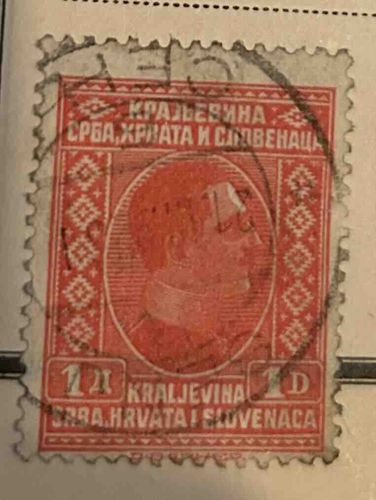
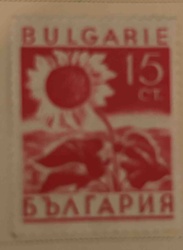
This is a vintage postage stamp from the Kingdom of Serbs, Croats and Slovenes, likely dating from the early 20th century, specifically the 1920s or early 1930s, given the Cyrillic and Latin inscriptions. The stamp is predominantly red or reddish-orange in color and features a portrait, in profile, of a male monarch, believed to be King Alexander I of Yugoslavia, encircled within a white or lightly toned circular frame. The portrait depicts him facing right, with a distinct sideburn and a formal collar. The background of the stamp outside the circular portrait is adorned with a repetitive geometric pattern, characteristic of traditional folk art or embroidery, adding cultural detail to the design. Along the top and bottom edges, inscriptions are visible in both Cyrillic script (Kraljevina Srba, Hrvata I Slovenaca) and Latin script (Kraljevina Srba, Hrvata I Slovenaca), which translates to 'Kingdom of Serbs, Croats and Slovenes'. The denomination '1 D' (1 Dinar) is clearly visible in the bottom left and right corners, enclosed in rectangular boxes. The stamp is perforated around all four edges, a standard feature for postage stamps, indicating it was designed to be separated from a sheet. The visible condition suggests it is a used stamp, as evidenced by a prominent circular postmark partially obscuring the top right and central portions of the stamp. This postmark is black and appears to have a date or cancellation details, though they are not fully legible. There is some minor wear consistent with its age and use, such as slight discoloration around the edges and minor creasing which is common for such items. The print quality appears decent for its era, showcasing fine lines in the portrait and clear text, indicating standard government-issued postage quality.
AI Appraisal Report
I have examined the provided image of the Kingdom of Serbs, Croats and Slovenes 1 Dinar Postage Stamp featuring King Alexander I. Based on the visual evidence, this appears to be an authentic stamp from the specified era, likely a common issue from the 1920s or early 1930s. The Cyrillic and Latin inscriptions, the portrait of King Alexander I, and the '1 D' denomination are consistent with known examples of this series.
The condition of the stamp is key to its valuation. The prominent circular postmark, while authenticating its usage, significantly impacts its collectible value as it obscures part of the design. Minor wear, slight discoloration, and potential creasing, as noted, are also factors reducing its grade. For philatelic items, a used stamp with a heavy cancellation and general wear is typically less desirable than an uncirculated (mint) or lightly cancelled example.
From a market perspective, these specific King Alexander I issues, especially the 1 Dinar denomination, are not considered rare. They were widely issued and are readily available in the philatelic market. Demand is generally moderate, driven by collectors specializing in Yugoslavian philately or historical stamps. Comparable items in similar used and cancelled condition typically trade for very modest sums.
Factors significantly impacting this humble value include its used state, the heavy postmark, and the general abundance of this particular issue. Without a clear view of the gum (if unused), full perforation integrity, and the absence of hidden faults (e.g., thinning, repairs), a precise high-end valuation is impossible.
To fully authenticate and precisely grade this stamp, a physical examination would be crucial. This would allow for a detailed assessment of paper quality, gum condition (if applicable), precise perforation count, and confirmation of any hidden flaws not visible in the image. Provenance documentation, while not usually critical for common stamps, could add slight value if it links to a notable collection. However, for an item of this type and condition, such extensive verification is generally not warranted given its low market value.